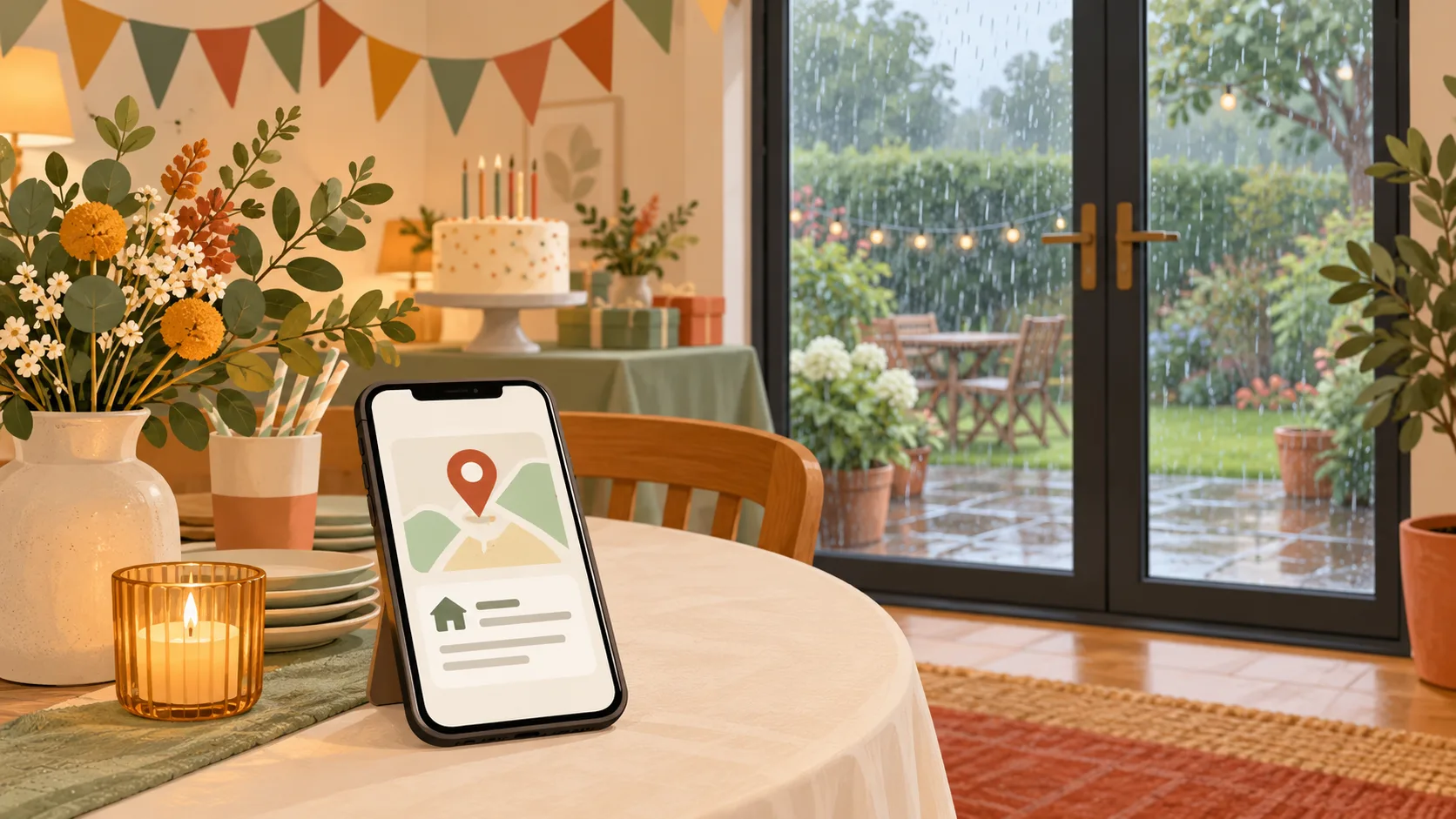
A useful birthday party rain note answers three questions: where is the indoor backup, when will the host confirm the location, and where should guests check before leaving? Write those details while planning the invitation, then send a separate, definite message if you decide to move inside.
For example: “We’re planning to celebrate in the garden. If we need to move indoors, we’ll use [confirmed room and venue]. We’ll confirm the location by [time and date] through [message channel]. Please check before setting off.”
That wording works only when the backup is genuinely arranged. A room you hope to book later should not appear as a confirmed alternative. The examples below are original templates; replace every bracketed detail with your agreed plan.
Choose the backup before choosing the words
Ask the venue or person responsible for the indoor space to confirm its availability, guest capacity, access and any booking conditions. Check the space for the full invited group, including accompanying adults, rather than counting only the people whose birthdays or ages appear on the invitation.
The wording changes according to the arrangement:
- Same property, different room: guests need the room name and entrance directions
- Different address: guests need the replacement address, a checked map link and enough notice to change their journey
- Different date: guests need a rescheduling message and a fresh attendance check
- No confirmed alternative: tell guests when you will update them, without promising that the party can move indoors
If the venue cannot accommodate the whole group inside, settle that issue before presenting it as the rain plan. Changing a location should not quietly change who is welcome.
Choose one person to confirm the decision with the venue and one reliable way to tell guests. They can be the same person. A relative’s guess in a group chat should not become the instruction everyone follows.
The five details a birthday rain note needs
Keep the main invitation cheerful and brief. Place the practical note near the location or guest-information section so it can be found again.
- The planned location. Name the lawn, garden or outdoor area specifically
- The arranged alternative. Include the room, building and address where needed
- The confirmation point. Give a time and date that you can realistically meet
- The update route. Say whether guests will receive a direct message, see a website update, or both
- The contact. Choose someone who can answer a last-minute location question
Set the confirmation point around real travel needs and the venue’s decision process. A message sent shortly before a party may be too late for guests already on the road. There is no single deadline that fits a garden gathering at home and a celebration requiring a long drive.
This is a communication plan, not a promise that weather or travel will be safe. Follow the venue’s decisions and relevant local guidance when conditions change.
Original invitation wording for four situations
1. Garden party with an indoor room at the same venue
“Join us for [name]’s birthday on [date], from [start time] to [end time], in the garden at [venue and address]. Our indoor backup is [room name] at the same venue. We’ll confirm which space to use by [time and date] in a message to invited guests. Please enter through [confirmed entrance].”
Use this when the same entrance genuinely serves both spaces. If the indoor room has a different gate or floor, give that information with the final update instead of leaving guests to search the property.
2. Outdoor party with a different indoor address
“We’re planning [name]’s birthday at [outdoor venue and address] on [date], [start time]–[end time]. If we move indoors, the arranged alternative is [indoor venue and address]. We’ll message you by [time and date] with the confirmed destination. Please check that message before leaving.”
A second address is easy to mistake for a second party stop. Label it “indoor backup” every time it appears before the decision. Avoid placing two equal map buttons together without explaining which one guests should use.
3. Short note for a compact invitation
“Outdoor celebration, with an indoor backup arranged. We’ll confirm the location by [time and date] through [channel]. Full details: [guest-information link]. Questions: [host contact].”
Use the short version only when the linked information includes the practical details guests need. For anyone who does not use the link, send the full note directly or explain it by phone.
4. A plan still awaiting confirmation
“We’re checking arrangements for the outdoor party and will confirm the location by [time and date]. Please wait for our update before making new travel plans. You can reach [host] through [contact route] if you need to plan sooner.”
This is an update while arrangements are unresolved. It should not be paired with “the party will go ahead indoors” unless that has been agreed. Once the situation is settled, send a new message that clearly gives the outcome.
When the move is confirmed, give one destination
A conditional invitation note prepares guests for a possible change. The final message tells them what to do now. Lead with the new location and repeat the date and party window so the message makes sense when read on its own.
“Birthday location update: we’ll celebrate indoors at [room, venue and full address] on [date], from [start time] to [end time]. Please come directly to this address; we won’t be using [original outdoor venue]. Use [entrance directions]. Map: [checked link]. Please reply ‘seen’ so we know you have the update. Questions: [host contact].”
If the time, activity or pickup arrangement also changes, state each change explicitly. For example: “Pickup is now from [indoor entrance] at [end time].” If everything else remains as planned, one short sentence can say so.
For a children’s birthday, moving from a park to a smaller room may affect where adults wait or how pickup works. Confirm the arrangement before sending it. The related guide on whether parents stay or drop off can help you make that instruction clear.
Avoid relying on “same details as before.” Guests may be looking at an older screenshot or a forwarded invitation with missing context.
What to change on the birthday website
A birthday website can hold the detailed plan beside the invitation. If you are using one, agree with its provider who will make time-sensitive changes and how quickly they can be made. Do not assume edits or guest notifications happen automatically.
When the move is confirmed, check these items together:
- Opening notice: make the confirmed indoor location easy to spot
- Event card: show the current address and party window
- Map button: point to the correct indoor venue or entrance
- Guest notes: update parking, floor, access and pickup instructions where relevant
- Rain-plan section: replace the unresolved condition with the confirmed decision
- Contact details: ensure the named helper knows the current plan
Include a clear update label such as “Location confirmed: [date and time]”. A meaningful label helps people distinguish today’s instruction from an old screenshot.
Open the actual shared link on a phone after the edit. Read the first screen, follow the map button and inspect the rest of the page for the old venue. Check any downloadable invitation separately: a saved file does not become current merely because the website changed.
You can explore the Love Solutions birthday website gallery when planning where those details should sit. Confirm the update process for the design and package you choose.
Make sure the message reaches the right people
Editing a page gives guests an updated place to check. You still need a plan for guests who have already read the invitation and will not reopen it.
Use a simple private list with one row per invited household: contact person, update sent, acknowledgement received, and follow-up needed. A reply such as “seen, we’ll come to the hall” is more useful than assuming that every group member noticed a message.
If someone usually receives details through another family member, ask that person to pass on the exact current instruction and confirm it arrived. For guests with a long journey or an imminent departure, use direct contact rather than waiting for a group-chat response.
Keep this list limited to the practical task. You do not need to collect explanations about why someone cannot attend the changed location. Give them a warm way to tell you their plans have changed.
An example of one consistent update
Imagine an entirely fictional party planned for a garden, with a community room already reserved as the backup. The host decides to use the room and changes the website’s main location. However, the map button still opens the garden entrance and the saved invitation image still says “Garden Party”.
Before messaging guests, the host checks all three. The website and map now show the room entrance. The message names the room and says to go directly there. Any replacement image is labelled as the current invitation. Guests receive one complete instruction with the date, time and destination.
This check takes the uncertainty out of phrases such as “we’re going with Plan B”, which make sense only to people who remember the earlier discussion.
Quick questions
Should we write “rain or shine”?
Use it only if you have an agreed arrangement that lets the celebration proceed and you explain where guests should go. By itself, the phrase leaves the indoor location and confirmation process unclear. It should never suggest that guests must travel despite unsafe conditions.
Should both locations stay visible after the decision?
Make the confirmed destination the obvious one. If you retain the old location to explain the change, label it clearly as no longer in use. Check map buttons and other prominent links too.
What if the party date also changes?
Treat that as a reschedule. Send the full new date, time and location, explain that the earlier invitation is superseded, and ask guests to confirm whether they can attend the new plan.
Can we just send the original video again with a new caption?
Guests may watch or forward the video without the caption. If it contains the old venue, ask the designer about a corrected version or send a clearly labelled current text invitation that includes all essential details. Make it easy to identify which instruction is current.
Before you share the final plan
Check that the indoor space is confirmed, the full group can be accommodated, one destination is prominent, the map is correct, and the message gives a date, time and contact. Then make sure the households travelling to the party have received the update.
For help presenting the invitation and guest information together, browse Love Solutions celebration services and explain your confirmed venue, backup arrangement and update needs in the brief. Clear wording begins with a plan the host and guests can both follow.