Three weeks before the sangeet, your phone looks busy — and your headcount still isn’t real.
One auntie replies “haan.” An uncle DMs “yes uncle, 4 people.” A cousin texts “maybe sangeet.” Someone reacts with 🙏. Someone else says “we’re coming” without saying who we is, or to which function. By Friday you are scrolling six chats into a Notes app, still unable to answer the caterer: how many plates for Saturday?
That is the failure mode of WhatsApp wedding RSVP culture in India — not that WhatsApp is wrong for sharing invites, but that chat was never built to compile guest data across mehndi, sangeet, ceremony, and reception. In 2026, more couples keep WhatsApp for reach, then move the reply into a structured layer. Here’s why chat headcounts collapse, what “good enough” looks like, and how to migrate without alienating elders.
The scattered “haan”: what actually ends up in your chats
If you have ever tried to finalise numbers from WhatsApp alone, you already know the pattern:
- “Haan” — one person? the whole household? blessing but not attending?
- “Yes uncle / yes beta” — polite, warm, and incomplete
- “4 people” — for which events? including kids? including a last-minute plus-one?
- “Maybe sangeet” — soft maybe that never becomes a firm number
- Emoji reactions — 🙏 and ❤️ feel affirming; they do not feed a catering sheet
- Group congratulations — beautiful noise that buries the one useful reply
Guests are not careless — you asked a logistics question in a medium built for conversation. Conversation rewards warmth. Catering rewards structure.
Why multi-function Indian weddings make chat RSVPs collapse
A single-evening reception with sixty local friends can survive on WhatsApp. A typical Indian wedding calendar does not — one household is rarely one answer.
Covers vs names
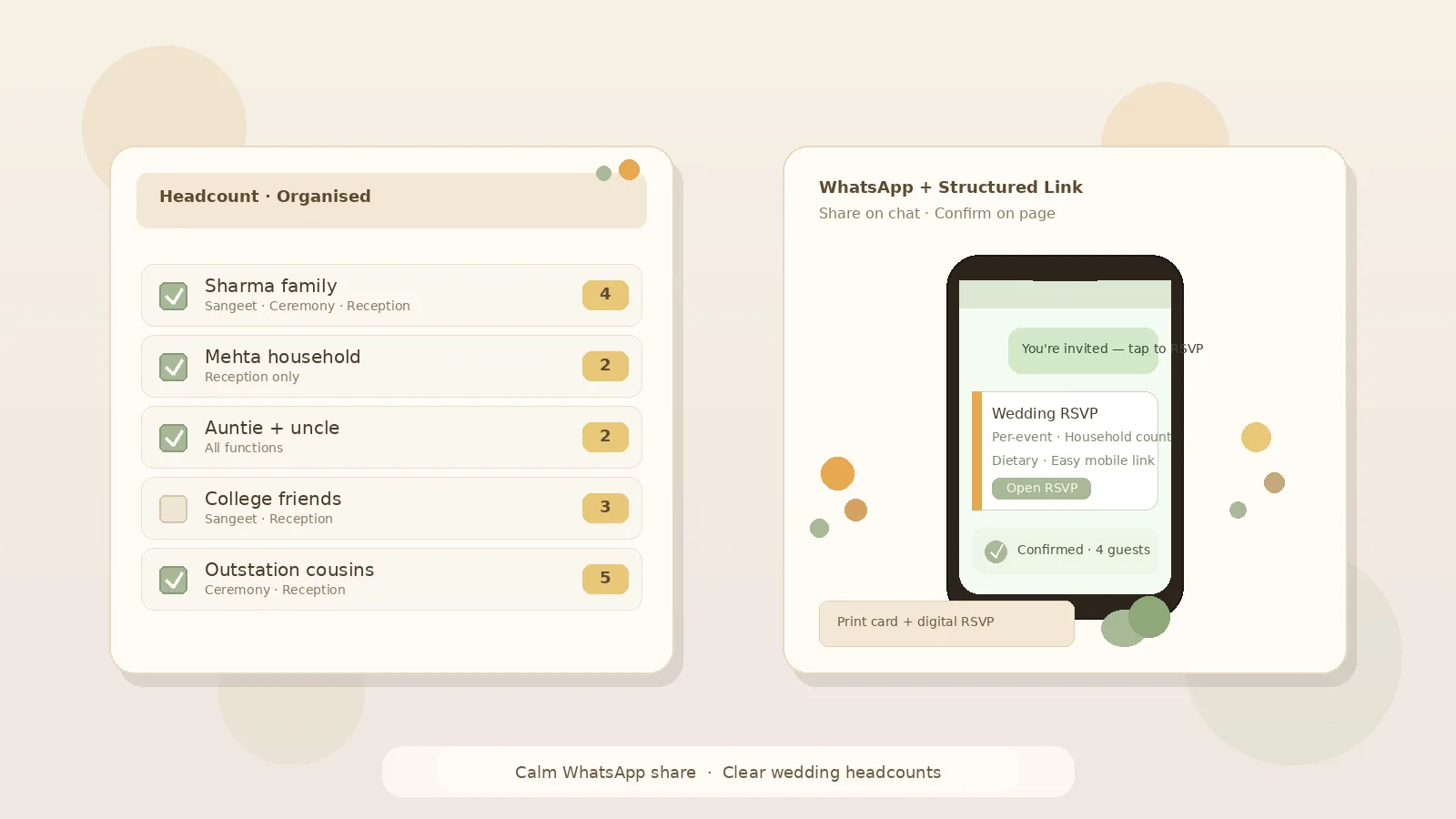
Your master invite list has names. Your venue and caterer care about covers per function. The same Sharma household might be:
- 2 for mehndi
- 4 for sangeet
- 5 for ceremony (elders joining)
- 3 for reception (kids staying back)
In chat, that becomes one blurry “we’re coming.” On a plate sheet, those are four different numbers. When families treat a WhatsApp yes as a single cover, they either over-order for every function or under-prepare for the one event everyone actually attends.
Dietary notes arrive too late
Vegetarian / Jain / no onion-garlic / allergies often surface the night before — or at the buffet. Chat threads bury them under congratulations. Structured RSVPs ask once, early, while the menu can still flex.
Outstation and NRI guests need more than a yes
Flights, hotel nights, and airport pickups are not emoji-friendly. When outstation cousins confirm in a group chat, someone still opens a second conversation for every practical detail. That chase is where exhaustion starts.
Last-minute adds have nowhere clean to land
Indian weddings absorb late “can we bring one more?” requests. In WhatsApp those land in different DMs, so the couple’s sheet and an auntie’s mental list diverge. Without one place to update household size and function tags, the final week becomes reconciliation theatre.
Nobody owns the compilation
Often mother tracks one group, a sister tracks college friends, and a cousin tracks the groom’s side. Everyone feels busy; no one has a live total. That is a system problem, not a people problem.
What “good enough in 2026” looks like operationally
Couples are not abandoning WhatsApp. Coverage through 2026 keeps pointing to the same shift: WhatsApp stays the distribution channel; structured confirmation becomes the system of record. You do not need a complicated stack — you need answers that become numbers.
Per-event answers, not one vague yes
Guests should be able to say yes/no (or not invited) for each function they were offered — mehndi, sangeet, ceremony, reception, and any welcome dinner. One link, multiple toggles, beats five separate chases.
Household form, not individual guesswork
Ask for the household name, who is attending, headcount (adults / children if it matters for seating or plates), and plus-ones on the same response. When “haan” becomes “Sharma family — 4 for sangeet, 2 for ceremony,” your sheet finally matches reality.
Deadline + reason (kind, not corporate)
A deadline works better when it comes with a human reason: catering lock, hotel block release, transport booking. Guests who love you will still forget. A clear date plus a warm reminder converts more soft maybes than another open-ended “please confirm.”
Family ownership blocks
Divide the guest list into ownership blocks: bride’s immediate family, groom’s immediate family, college friends, colleagues, neighbours. Give each block a family ambassador who nudges elders and reports exceptions. WhatsApp stays useful here — for personal follow-up — once the structured form holds the baseline answers.
Hybrid print + digital is still normal
Many Indian households still want a printed card. That is fine. The card (or a photo of it) can carry a short line and a mobile link, QR, or “RSVP on our wedding page.” Print for honour; digital for headcount.
A practical pattern: share a warm WhatsApp note with the invite, then point guests to a mobile wedding website with RSVP / clear guest info as the structured layer behind the message — chat carries the relationship; the page carries the numbers. That soft layer exists so you are not rebuilding a spreadsheet from screenshots at midnight.
Migration playbook: WhatsApp-only → WhatsApp + structured link
You can change the system without making elders feel corrected.
Step 1 — Freeze the question you need answered
Write the minimum fields before you send anything:
- Household name
- Functions attending
- Headcount
- Dietary notes
- Outstation / stay needs (if relevant)
- Contact for day-of updates
If a field will not change catering, seating, or stay plans, leave it out. Friction kills completion.
Step 2 — Keep WhatsApp as the envelope
Do not move the relationship to email. Send (or forward) a short personal note:
“We’ve put RSVP details on a simple mobile page so we don’t miss anyone’s preferences for sangeet and the wedding. Please tap and confirm by [date] — it takes a minute. Call us if you’d rather we fill it for you.”
That last line matters. It tells elders there is dignity in asking for help.
Step 3 — Offer family-ambassador fill-in for elders
Assign one trusted relative per branch to complete the form with older guests on a call or home visit. Many grandparents will happily confirm verbally; they should not be forced into an app they dislike. The structured record still gets created — you just change who types.
Step 4 — Run a two-wave confirmation
- Wave 1: Share the link with the invite (or shortly after).
- Wave 2: Personal WhatsApp follow-up only to non-respondents, naming the functions you still need.
Broadcasts to mute-prone groups underperform. Named nudges from a familiar number work better.
Step 5 — Reconcile chat exceptions into the same sheet
Some people will still reply “haan” in chat. Treat that as a lead, not a final. Transfer it into the structured list the same day, and reply: “Noted — I’ve marked 2 for reception; tell me if sangeet changes.” You train the household gently toward clarity without scolding.
Step 6 — Lock a decision date, then manage exceptions
Pick a catering-facing freeze date. After that, changes go through one owner (often the couple or a sibling), not through three auntie threads. Last-minute adds still happen — they just stop rewriting history in five places.
Checklist: from chat chaos to usable headcounts
Use this the week you stop collecting RSVPs “only in WhatsApp”:
- [ ] Master list tagged by function (invited vs not invited per event)
- [ ] One structured response path (mobile page / form) for per-event + household count
- [ ] Dietary and kid/adult fields where they affect plates or seating
- [ ] Outstation stay questions only for guests who might need them
- [ ] Public RSVP deadline with a catering/hotel reason
- [ ] Family ambassadors assigned for elder-heavy branches
- [ ] WhatsApp script ready: share link + offer to fill on their behalf
- [ ] Weekly export or snapshot for caterer / decorator / transport
- [ ] Single owner for post-deadline changes
- [ ] Soft buffer mindset: some confirmed guests miss a function; some unconfirmed locals still arrive — plan with your venue, not with hope alone
FAQ
Is WhatsApp bad for Indian wedding RSVPs?
No. WhatsApp is excellent for sharing invites and for personal follow-ups. It is weak as the only place where answers live. The 2026 pattern is hybrid: chat for distribution, structured RSVP for headcounts.
Why does “haan” break headcounts so quickly?
Because it skips the fields that multi-function weddings need — which events, how many people, dietary needs, and whether plans are firm. At small scale you can chase; past roughly a hundred guests and three-plus functions, chasing becomes a second job.
Will elders refuse a digital RSVP link?
Some will prefer a call. Build that path in from day one: family ambassadors fill the form while speaking with elders. Respect the preference; still capture the data.
Do we need a different RSVP for every function?
Guests should answer per function, but they should not need five different links. One mobile flow with clear event names is enough for most families.
What should we tell the caterer when WhatsApp replies still trickle in?
Give them your structured confirmed number on the freeze date, plus a small agreed buffer for known late locals if your venue allows. Do not keep reopening the whole sheet every time a group chat pings.
Can we still send printed invitations?
Yes. Pair print with a short RSVP line or QR to the same structured page. Hybrid feels traditional and still produces usable numbers.
Closing: keep the warmth, stop guessing the count
Indian weddings run on relationships. WhatsApp will keep carrying the congratulations, voice notes, and “beta, we wouldn’t miss it.” What couples are switching away from in 2026 is not WhatsApp — it is treating a chat thread as a guest database.
When “haan / yes uncle / 4 people / maybe sangeet” can become per-event, household-clear answers, you get fewer panic calls, kinder elder follow-ups, and headcounts vendors can cook and seat for.
Share the love on WhatsApp. Collect the numbers where they can add up.