Indian wedding guests rarely struggle with “what time is the cocktail hour?” They struggle with mehndi colours, whether the driver’s thali is arranged, if children may stay for a late sangeet, where colleagues should sit during pheras, and whether an envelope of shagun is still expected.
A wedding website FAQ page in India exists to answer those repeat questions once, kindly, and in language families actually use — so the same uncle is not messaging four cousins for the same parking note.
This guide is for couples and parents building that page for a multi-function wedding, including outstation and NRI guests. It is about the FAQ page specifically: which questions earn a place, how to write answers, and how to keep the FAQ from fighting the rest of the site.
The FAQ’s job (and what it is not)
The FAQ answers questions that change what a guest does next: what to wear, whether to bring children, where to stay, how to gift, whom to call.
If the answer is already obvious on the schedule (“Saturday 10:30, Temple Hall”), do not rewrite the whole timetable in FAQ form. Point to that section.
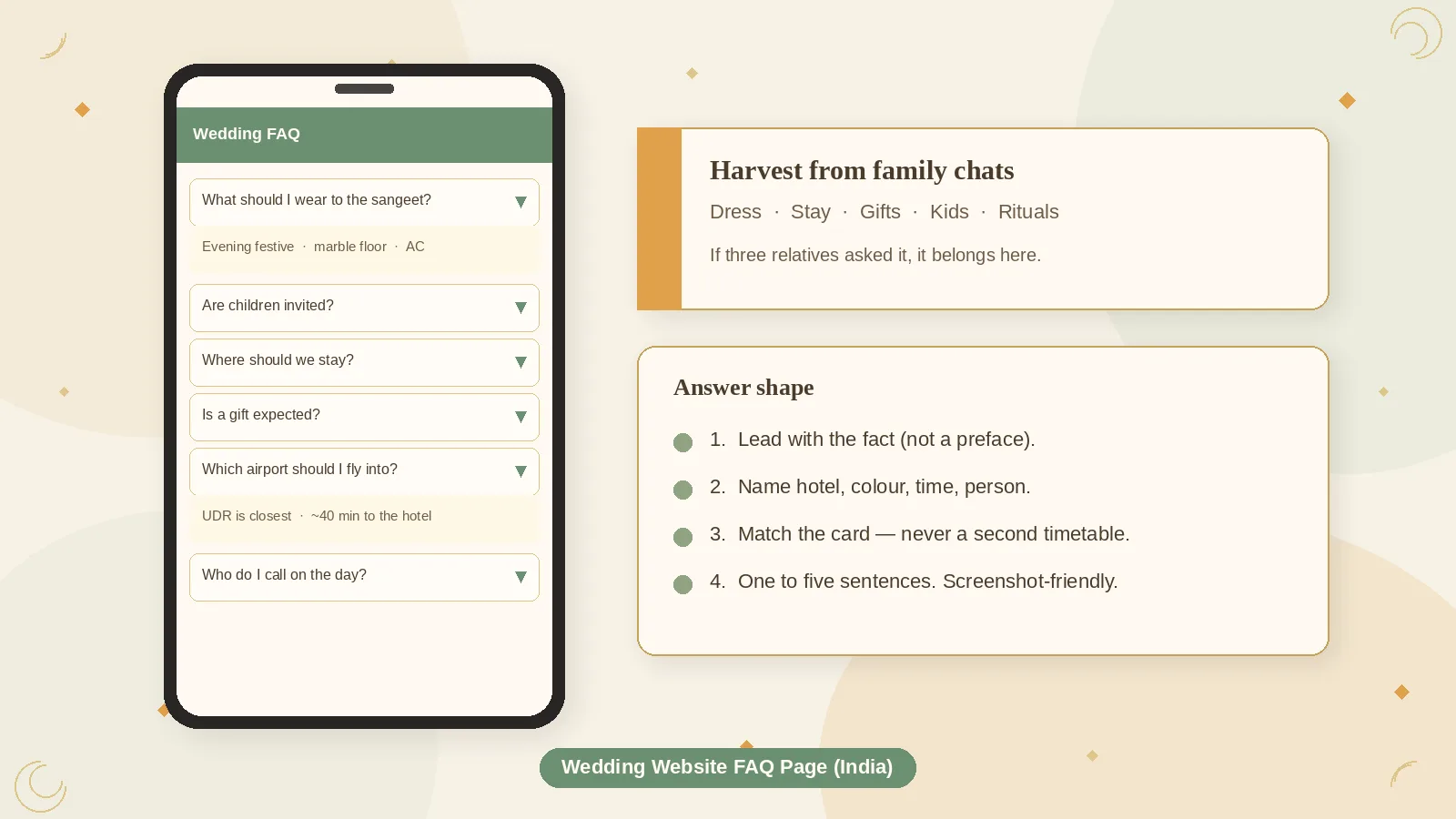
If three relatives have already asked the same thing in WhatsApp, it belongs on the FAQ.
The FAQ is not:
- Your love story
- The vendor call sheet
- A second, conflicting timetable
- A legal essay about gifts
- A place to negotiate unresolved family decisions in public
Publish what is true. If the reception venue is still a maybe, do not invent a confident parking answer.
Harvest questions from real chats, not from a Western template
Before you copy a generic list, scroll the last month of family WhatsApp. Cluster what people actually asked:
- Dress and colours
- Getting there and parking
- Stay and who pays
- Food and drink
- Children and extra adults
- Gifts
- Rituals for friends who have never been to this kind of wedding
- Day-of contacts
Write in the register your guests use. A short bilingual FAQ (English plus Hindi, or English plus the family language) often helps more than a poetic English-only page. You do not need a perfect translation of every line — the five highest-volume answers are enough.
Core questions worth answering
Use these as a menu. Delete anything that does not apply. Add the odd question only your families ask (a temple footwear rule, a monsoon backup, a no-photography mandap).
Dress and what to pack
Guests want practical clothing, not a moodboard.
Sample shape: “Mehndi: festive day Indian, pastels or yellows; the lawn is grass, so avoid stilettos. Sangeet: evening festive; indoor AC, marble floor. Ceremony: traditional; covered shoulders for the mandap if that is your family custom. Reception: formal Indian or western. Outdoor functions can run warm; keep a stole for AC halls.”
Name colours you genuinely care about. “Festive chic” means nothing to an eight-year-old’s father packing in Chandigarh.
Getting there
- Full venue name, short address, map link (do not paste this only in FAQ if it already lives on the schedule — a one-line “maps are on the Schedule page” is fine, plus parking)
- Parking, drop-off for elders, whether ride-hailing is reliable after 11 pm
- Shuttle lobby and time, if you have one
- Which airport or station to use when two options exist
Stay
State the awkward part in one sentence: hosted rooms versus a block guests pay themselves versus “here are two hotels we like.” Include the booking code, cut-off date, and who to WhatsApp if the link fails. Guests from other cities plan around this more than around your colour palette.
Food and drink
A FAQ is the right place for orientation, not a full catering spreadsheet: vegetarian as default if that is true; Jain / satvik / halal notes if you are offering them; alcohol or dry functions; a line on how to flag allergies. Keep it short. The RSVP can collect specifics; the FAQ should stop people guessing.
Children and extra adults
Indian invitations that say “and family” are read as children included unless you say otherwise. The FAQ should match the card:
- “Children are welcome at all functions; please add names and ages when you RSVP.”
- “Kids are welcome at mehndi and the ceremony; the sangeet is an adults’ evening.”
- “We are keeping the reception adults-only so we can host a late evening. We hope you understand — please see the invite for who is named.”
Do not hide an adults-only rule only in the FAQ. The card and the FAQ must agree.
Gifts
Write the truth you are willing to stand behind. Common, calm options:
- “Your presence is the gift; if you wish to bless us, a simple envelope is traditional in our families.”
- “We are not keeping a registry. Please do not send large parcels to the venue.”
- If you do have a registry or a fund, one sentence and a link — not a pitch.
Avoid humour at the expense of elders who consider shagun compulsory.
Rituals for first-timers
Colleagues and college friends need a few lines, not a textbook: how long the ceremony may run, whether guests stand or sit, footwear, who may come to the mandap, and whether phones are welcome. NRI cousins who have not attended this family’s customs need the same courtesy.
Accessibility, weather, and “who do I call?”
Ramps, chairs with backs, a quiet room, monsoon backup, heat on a lawn — three honest sentences prevent miserable surprises. Then name two people with roles and hours: bride-side coordinator, groom-side coordinator. “Ask in the group” is not a contact.
How to write answers guests will actually read
- One to five sentences per question. If you need a paragraph plus a list, the topic may belong on its own page with a FAQ pointer.
- Named facts. Hotel, colour, time, phone — not “details will be shared soon.”
- Host voice. “We” and “please” beat “guests are requested to kindly…”
- Identical facts across invite, schedule, and FAQ. The FAQ should never be the one place with a different time.
Lead with the answer, then the reason. “The sangeet is adults-only. It runs late with a loud DJ, and we cannot staff a children’s room that night.” Reasons reduce offence. Policies without reasons invite debate.
How to structure the page on a phone
Group by topic, not by alphabet. Put the five questions you are already tired of answering at the top.
On mobile, short headings with the answer immediately below work better than a tiny accordion that hides everything. Guests should be able to screenshot one answer and send it to a parent.
A mobile wedding website is a natural home for this FAQ beside the schedule and RSVP — that is the guest-communication flow tools such as LoveSolutions are built around. Use whichever site your families will actually open; the structure matters more than the brand.
What to leave off
- Internal family politics and who is not speaking to whom
- Vendor phone numbers guests do not need
- Jokes about relatives
- Duplicate full schedules
- Answers you are still negotiating
If a question is sensitive (who pays for rooms, whether a particular cousin is invited), answer it on the page in general language, and handle the named exception privately.
Keep the FAQ in sync
Give the page one owner. When the sangeet venue changes, the parking answer changes the same hour. Put a tiny “Last updated: [date]” at the top if you expect travel-heavy guests to bookmark it.
Do not “update” the FAQ with five contradictory WhatsApp voice notes. Change the page, then send one message: “FAQ updated — venue gate is Gate 3.”
A simple FAQ-page checklist
- [ ] Questions harvested from real family chats, not only a template
- [ ] Dress notes are practical (surface, heat, AC, footwear)
- [ ] Stay and who-pays is stated in one plain sentence
- [ ] Children / extra-adult rule matches the invitation wording
- [ ] Gift note is honest and not sarcastic
- [ ] First-timer ritual lines exist if colleagues or NRI friends are coming
- [ ] Two named contacts with roles
- [ ] No second timetable that can drift from the schedule page
- [ ] English plus a family language for the top answers, if useful
- [ ] One owner, one “last updated” habit
FAQ
How many questions should a wedding website FAQ have?
Enough to absorb repeats, not so many that guests stop scrolling. For many Indian weekends, 10–18 good answers beat 40 thin ones. If a topic needs a map and three timings, link to the schedule instead of stuffing it here.
Should the FAQ be in Hindi or English?
Use the languages your guests read. English-only is fine for some friend lists and unfair for some parent lists. A mixed page is allowed. Clarity beats matching fonts.
Do we still need an FAQ if we have a busy WhatsApp group?
Yes. Groups bury answers. A page can be opened at the airport at 1 am without asking someone to scroll. The group can carry the link; it should not be the archive.
Where should the FAQ sit on the site?
One tap from the home screen — a tab or a clear button — not buried under the love story. Outstation guests often open FAQ before Our Story.
Closing thought
A useful wedding website FAQ page sounds like a calm host in the room: specific, kind, and consistent with the card. Write the answers you are already repeating, keep them short, and update them when the truth changes. Guests will still message you — just not about the map pin.