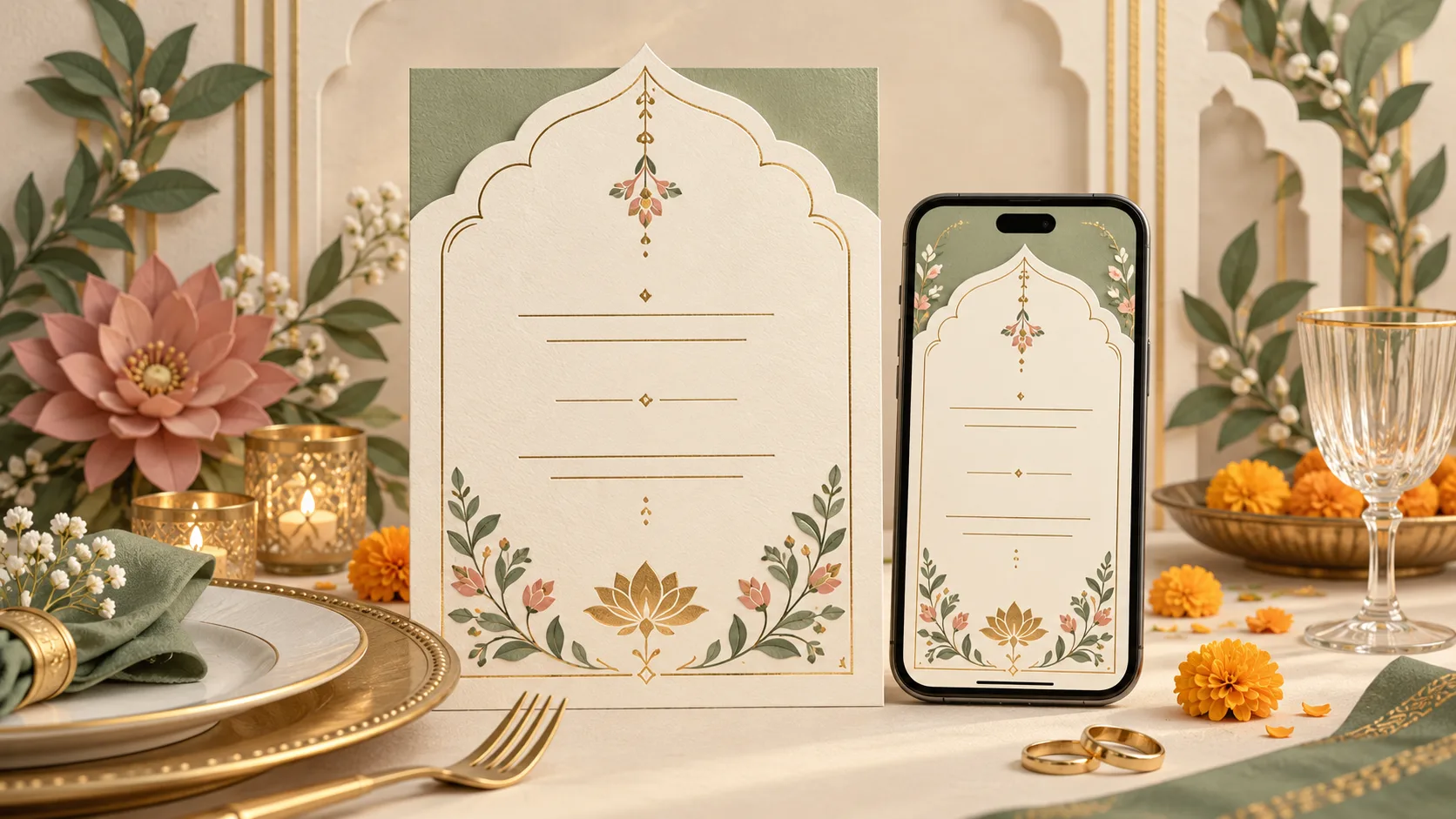
A reception-only wedding invitation should say reception near the beginning, give the date and time of that celebration, and warmly invite the guest to join you. If the ceremony is private or has already happened, one short sentence can explain that when it is helpful.
The tricky part is keeping every version consistent. A card may say “reception” while its accompanying video says “join our wedding celebrations” and the website opens with a ceremony countdown. Guests then have to work out which event they should attend.
This guide gives you wording to adapt for different hosts and situations, followed by a practical way to carry the same invitation into a website, video and WhatsApp message. All bracketed details are placeholders. Replace them with confirmed information before sharing.
Start with this simple reception invitation
Together with our families, [Name] and [Name] warmly invite you to their wedding reception. Join us for dinner and an evening of celebration. [Day, date, month, year] Guest arrival: [time] [Venue, hall or lawn, city] Please RSVP by [date] at [link or contact].
Use “dinner” only if dinner is part of the plan. Change it to “lunch,” “refreshments” or another accurate description when needed. Include a finish time if guests need one for transport or venue arrangements.
You do not need to print “reception only” as a warning. A clear heading, one reception schedule and a matching response question can explain the invitation more gracefully.
Decide which date the guest needs
There may be two important dates: the wedding ceremony and the reception. The date beside the invitation's time and venue should be the reception date.
If you want to mention an earlier ceremony, make the distinction explicit:
Married on [ceremony date]. Celebrating with you at our reception on [reception date].
Do not place both dates in identical decorative boxes without labels. A guest scanning a small phone screen could save the wrong one.
If the ceremony is still ahead when you send the invitation, avoid wording that suggests it has already happened. “Following our private wedding ceremony, we look forward to celebrating with you” suits a future event. “We were married in a private ceremony” belongs in a message sent after the ceremony.
Five reception-only wording examples
Choose the version closest to your actual arrangement. There is no need to fit every family into one formal script.
1. Both families hosting
With the blessings of our families, [Host names or family names] warmly invite you to celebrate the wedding reception of [Name] and [Name]. Please join us for dinner and celebration on [reception date] at [arrival time], [Venue, hall or lawn, city]. Kindly reply by [RSVP date] through [link or contact].
Keep the host line readable. When a long list of names makes the card crowded, agree on a shorter family line and place any approved extended acknowledgement elsewhere on the website.
2. Parents inviting guests
[Parent or host names] request the pleasure of your company at the wedding reception of [Name] and [Name]. We look forward to welcoming you on [reception date] at [arrival time], [Venue, hall or lawn, city]. Dinner will be served from [time]. RSVP: [deadline and contact].
Add a relationship such as “our daughter” or “our son” only if the hosts want it and it accurately describes the people named. A joint host line should not accidentally assign the wrong relationship to one side of the family.
3. The couple inviting guests directly
We would love to celebrate our marriage with you. Please join us for our wedding reception on [reception date] at [arrival time]. [Venue, hall or lawn, city] An evening of [confirmed activities] awaits. With love, [Name] and [Name] Please let us know by [RSVP date] if you can join us: [link].
“Dinner and conversation” can be enough. Do not promise dancing, live music or an elaborate programme simply because a sample invitation includes it.
4. A reception after a small private ceremony
We were married in an intimate ceremony and would love to celebrate with you. Join [Name] and [Name] for a wedding reception on [reception date] at [arrival time], [Venue, hall or lawn, city]. Your company would mean so much to us. Please RSVP by [date] at [link or contact].
The opening provides context without explaining private family circumstances. Use it only after the ceremony; otherwise change it to “Following our intimate wedding ceremony, we would love to celebrate with you.”
5. A hometown reception after a wedding elsewhere
Our wedding celebrations continue in [reception city]. Please join us for the wedding reception of [Name] and [Name] on [reception date] at [arrival time], [Venue, hall or lawn]. We look forward to sharing an evening with you. Please reply by [RSVP date] through [link or contact].
This works when the wedding and reception take place in different cities or on different days. Check that the map, calendar button and WhatsApp message all point to the hometown reception.
Wording that can accidentally invite guests to the ceremony
A beautiful design can still send the wrong message. Review these phrases in their context:
- “Wedding and reception” suggests an invitation to both. Use “wedding reception” when that is the event offered
- “Reception to follow” does not give reception-only guests a usable arrival time. State when they should arrive
- “Join us as we exchange vows” invites the reader to witness the ceremony. Choose “join us to celebrate our marriage” for a reception
- “All wedding functions” suggests a wider invitation. Name the reception directly
- “You and your family” broadens the guest invitation. Use it only when that is intended
Warmth comes from the greeting and the personal message. It does not require vague event details.
If someone asks about attending the ceremony, reply privately and simply:
The ceremony will be a small gathering. We would love to celebrate with you at the reception on [date] and look forward to seeing you there.
Do not add an explanation about capacity, budget or family decisions unless you genuinely want to share it.
What the reception website should show
A reception invitation website should answer the questions raised by this particular invitation. A useful page order is:
- Reception heading and couple names
- Reception date, guest arrival time and any relevant finish time
- Venue name, specific hall or lawn, city and verified map
- Short meal, dress or access notes
- Reception RSVP deadline and response option
- A contact for questions
If guests may arrive before the meal starts, label both times: “Welcome from [time]; dinner from [time].” Avoid “onwards” when the guest needs a defined arrival window.
A couple story or photo section can sit below the practical details. Check that a decorative countdown is counting down to the reception date rather than an earlier ceremony.
Keep other functions out of the reception guest's path
When some guests attend the ceremony and others attend the reception, test what each invitation link actually reveals. Do not assume a page is private because it is missing from the main menu.
Ask your provider which event-visibility controls are included and test a reception guest's view without using the organiser's account. Where the chosen setup cannot reliably separate events, a dedicated reception page may be the simpler option.
For the wider planning process, see our guide to inviting guests to mehendi, sangeet and reception separately. The wording here focuses on making the reception invitation complete in its own right.
Adapt the message for a video invitation
A reception video needs to identify the event before decorative scenes make the context unclear. Keep the key facts visible as text, even when the video includes music or a voiceover.
Use this content sequence:
- Opening: “Please join us for our wedding reception”
- Names: The couple's approved names
- Invitation: A short family-hosted or couple-hosted line
- Details: Reception date, guest arrival time, venue and city
- Closing: RSVP deadline and a direction to the accompanying website link
Do not put a long address, two event dates and a full host list on one fast-moving scene. Give the practical details enough time to read and include them in the message that accompanies the file.
A video thumbnail should also identify the reception. Reusing a ceremony-only cover can make the video appear to be the wrong invitation before anyone presses play.
Copyable WhatsApp messages
Send the invitation from a number the recipient recognises, with a personal greeting. The message should still make sense if the guest reads it before opening the attachment.
From the couple
Hi [guest name], we would love you to join us for our wedding reception on [date] at [time], at [venue, city]. The details and RSVP are here: [website link]. Please let us know by [RSVP date]. We look forward to celebrating with you! [Couple names]
From a parent or family host
Dear [guest name], we warmly invite you to the wedding reception of [Name] and [Name] on [date] at [time], at [venue, city]. Please find the invitation and reception details here: [website link]. Kindly confirm by [RSVP date] through [response method]. With warm regards, [host name]
When sending a video
Hi [guest name], here is our reception invitation. We would love to see you on [date] at [time], at [venue, city]. You can find the map and RSVP details here: [website link]. With love, [couple names]
Name the invited people or household clearly in your own sending list. Check that the greeting and the response options agree with that invitation.
Ask an RSVP question about the reception
“Will you attend the wedding?” can be ambiguous when there is a separate ceremony. Use:
Will you join us for the reception on [date]?
Offer a clear way to accept or decline. If the invitation covers more than one person, let the household identify which invited guests will attend rather than recording one unqualified “yes.”
Keep the RSVP deadline consistent across the card, video, website and message. Choose it using the venue or caterer's actual planning needs. A copied deadline from a design sample is not a reliable guide.
A final check before sending
Ask someone who has not helped plan the event to open the exact message and link you will send. Ask them:
- Which event are you invited to?
- Which date would you save?
- What time would you arrive?
- Which venue and entrance would you use?
- How would you tell the hosts whether you are coming?
Then check the details they cannot easily see: the calendar entry, map destination, mobile video cover and guest-specific page view. If you are making a bilingual invitation, check that both languages name the reception and give identical dates and times.
Send a test to one trusted reviewer before sharing the invitation widely. Correct the master wording first, then update every format affected by the change.
Frequently asked questions
Should we say “reception only” on the invitation?
Usually a prominent “wedding reception” heading and a single reception schedule are sufficient. Use a direct private explanation if a guest is unsure. Avoid leaving a ceremony invitation visible elsewhere in the same file or page.
Do we need to explain why the ceremony is private?
No detailed explanation is necessary. If context helps, “following an intimate wedding ceremony” is a short, warm option. Share only what you are comfortable telling every recipient.
Can the same design work for ceremony and reception guests?
Yes, the visual design can match. The wording, event information and RSVP choices still need to suit each guest group. Ask the provider to confirm the production and page-access setup before sending either version.
Should we include the original wedding date?
You can include it as part of the story, clearly labelled. Keep the reception date dominant wherever guests find the time, venue, RSVP and calendar action.
Choose the design after the wording is clear
Once the event, hosts and guest details are agreed, explore the LoveSolutions wedding website collection. Ask how your preferred design can present a reception-focused page and what is included before confirming the work.
Bring the approved wording, venue details and one clear list of required formats to the design discussion. That gives the website and video a consistent starting point and gives guests a warm invitation they can understand on the first read.