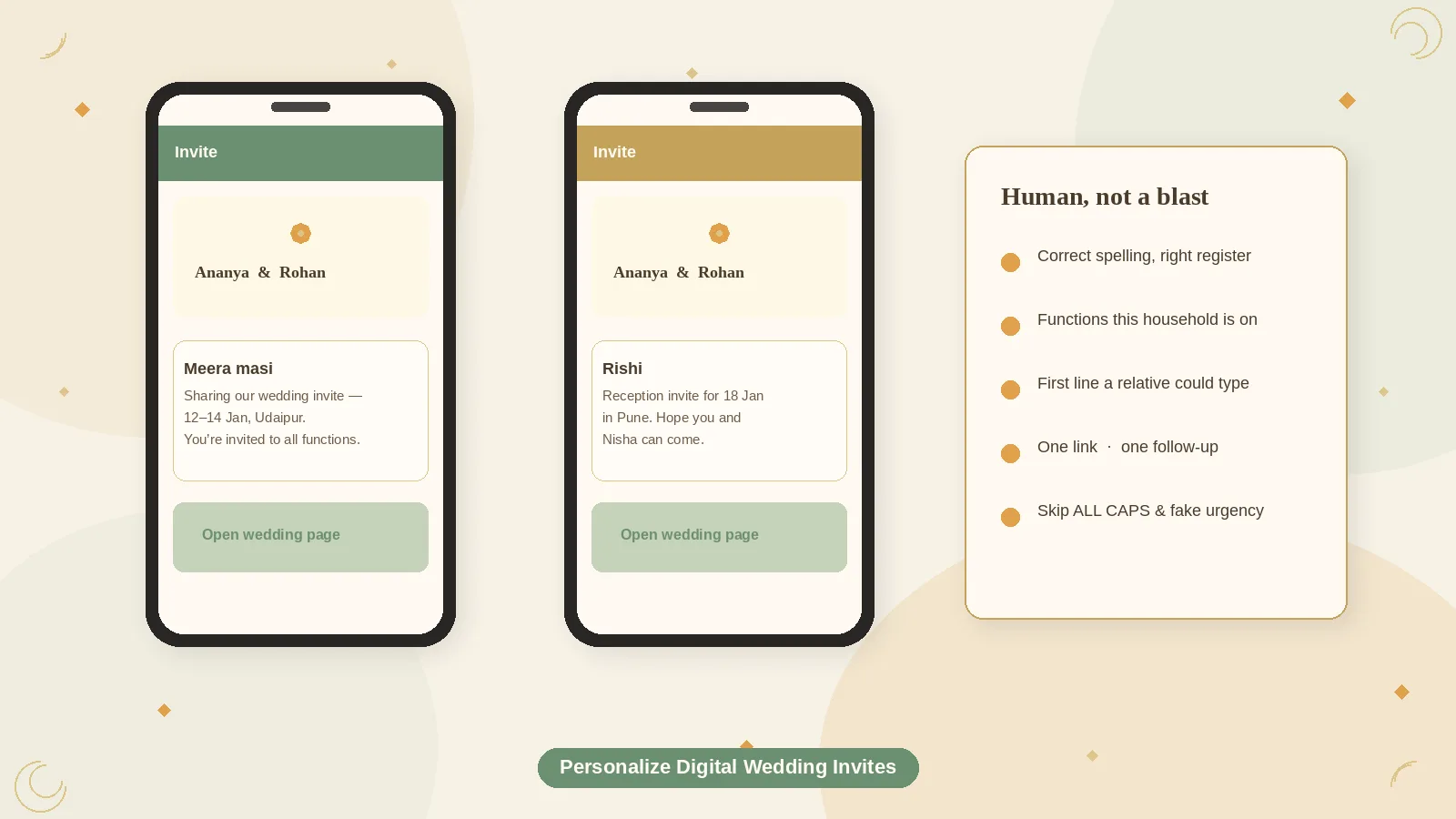
A digital invite with the wrong first name feels worse than a plain “Dear Guest.” Personalization is hospitality when it is accurate and human. It is spam when it is merge-fields, fake urgency, and a message that could only have been blasted to four hundred people.
This guide is for Indian couples and families sending personalised digital wedding invites on WhatsApp, email, or a guest page — and wanting them to feel like a note from the household, not a campaign.
What guests actually notice
They notice:
- Their name spelled the way the family spells it, not the passport
- Which functions they are invited to
- A first line that could only come from you or your parents
- The language and register of your home (English, Hindi, Tamil, a mix not “Esteemed Sir/Madam”)
They do not need a unique poem per cousin. Over-customising the art and under-customising the greeting is how digital invites start to look like ads.
Household versus individual
Most Indian invitations are household objects. Digital sending makes it easy to over-ping.
Prefer one message per household when people live together: name every invited adult (and children, if they are invited) in a single note. Four identical “Dear Sharma Family drops in a family group of four feels like a bot.
Send separately when adults live in different cities, when cousins should not see each other’s plus-one status, or when one person is reception-only and another is on the full weekend.
Do not mix those logics in one broadcast. The personalization that matters is who this note is for, not a first-name token stuck on a poster.
The first line is your subject line
On WhatsApp, the first line is all many people see before they decide whether to open the link.
Feels like spam
- “INVITATION!!! Kindly click below to grace the auspicious occasion.”
- “You are receiving this because you are on our guest list.”
- Exclusive link — expires soon.”
- A wall of emojis, then a URL.
Feels like a person
- “Meera masi, sharing our wedding invite — 12–14 Jan, Udaipur. You’re invited to all functions.”
- “Rishi, this is the reception invite for 18 Jan in Pune. Hope you and Nisha can come.”
- Uncle, Amma asked me to send you the card. Haldi is family-only; you’re on sangeet and the wedding.”
Lead with name + city/dates + which events. Put the link after one human sentence. People who love you will open a calm note. People who skim will still get the facts.
Name merge done right (and the ten households to proof)
If you use a guest list to fill names, treat it as typesetting, not magic.
- Nicknames versus formal names by generation. Your college group is “Kabir.” Your mother’s friend is “Kavita Aunty,” not “Kavita.”
- Both families’ customs. One side says “Sharma uncle; the other uses first names. Match the relationship, not the spreadsheet column.
- Spellings NRI relatives actually use. Aishwarya versus “Ash”; “Mohammed” versus “Mohmad.” Ask once if you are unsure.
- Initials and double barrels. “P.K. Iyer” may never have been “Pramod” on a wedding card.
- Household labels. “The Khannas” is fine if that is how you address them in life. It is chilly if you have always said “Ritu and Alok.”
Proof ten tricky rows before you send the rest: hyphenated names, two families in one house, widows, priests, bosses, the cousin whose name you have always misspelled. Wrong-name personalization is worse than none.
The highest-value personalization is the function list
A reception-only guest who receives a four-day trailer will plan the wrong trip — or feel awkwardly over-included. A full-weekend aunt who receives only the pheras card will miss the mehndi she was meant to host.
Build versions, not just names:
- Full weekend
- Sangeet + wedding + reception
- Ceremony and lunch only
- Reception only
Same dates and same city on every version. Different “you are invited to” lines. That is real personalization. A gold overlay of their first name on the thumbnail is optional garnish.
Design versus wrapper
Two layers:
- The invite itself — video, image, or page. Keep it stable, beautiful, and accurate.
- The wrapper — the WhatsApp or email lines around it. This is where most personalization should live.
Putting a guest’s name inside the artwork is lovely when optional and disastrous when wrong (and expensive to fix). A shared invite plus a named wrapper is safer for large lists. Save named covers for a short VIP set if you want the flourish.
Digital invites and wedding websites from studios such as LoveSolutions work well when the page is one source of truth and the chat line is the human part. The tool can carry the name; you still owe the sentence.
What looks spammy (even with a correct name)
- ALL CAPS and “KINDLY CONFIRM
- Fake countdown pressure (Only 48 hours to RSVP”) when the real deadline is weeks away
- “Exclusive link just for you” when it is the same public URL
- Tracking parameters that turn a nice link into something that looks like an ad
- Sending at 11 pm from an unknown business number with a green badge when families expected a niece’s personal chat
- Identical messages dropped into a large group, tagged with @everyone
- Over-familiar jokes in a note to elders
- A second follow-up every three days
Bulk is a method. It should not be an aesthetic. If you send from a business API or a helper’s phone, say who is sending: “Message from Ananya (Meera’s daughter) on behalf of the family.
Voice: whose mouth is this?
Match the card.
If both families host, the WhatsApp can come from the parent who actually knows that guest. A cousin blasting “our wedding” to the bride’s father’s office colleagues will feel off, even with perfect merge fields.
Write three wrapper templates, not one:
- Elders and parents’ friends (more formal, function list, respect)
- College and work friends (warmer, shorter, dress hint if useful)
- Outstation / NRI (dates, city, stay one-liner, link)
Personalization is often register, not rhymes.
A simple personalization stack
- Correct names and spellings
- Correct functions for that household
- One human first sentence
- One link
- Who is sending
- One follow-up, not five
That is enough. If you have energy left, add a dress hint or a hotel line. If you do not, stop. A clean stack beats a “unique” paragraph that still says “Dear Guest” in the first line.
Checklist before you hit send
- [ ] Ten awkward names proofed by someone who knows both families
- [ ] Function versions match the actual guest list
- [ ] First WhatsApp line has name, dates/city, and events
- [ ] Link is short and the same destination for everyone in that version
- [ ] No fake urgency, no ALL CAPS
- [ ] Sender is identifiable as family
- [ ] Elders notes are in a register they will not find rude
- [ ] You are not dumping the same text into a 200-person group as the only “personal” step
- [ ] Follow-up plan is one reminder, then a phone call for close people who have not replied
Common mistakes
- Wrong name, beautiful card. Apologise and resend; do not hope they did not notice.
- Personal cover, generic events. They saw their name and still cannot tell if they are on Friday.
- Group blast plus hi {{name}}.” Everyone can see the token failed — or that it did not.
- English-only formality to a family that never speaks that way. Stiff language reads like a bank SMS.
- Over-tracking. If the URL looks like marketing, people hesitate to tap.
FAQ
Is it okay to send the same invite file to everyone?
Yes. Personalize the wrapper and the function version. The file can be shared; the sentence should not be.
Should we put each guest’s name on the video thumbnail?
Only if you can guarantee spelling and you are not sending so many variants that a mistake is likely. For large lists, skip it.
How do we personalize without a guest-list tool?
Type. Send in batches by relationship: masi’s cluster, office cluster, college cluster. Slow sending is still faster than a week of corrections.
What about guests who share one family phone?
Address the household, not four first names stacked as if they each have a screen. “Sharma uncle and family — please share with Ritu and the boys” is clearer.
Closing thought
Personalization that does not look spammy is mostly accuracy plus tone. Spell the name as they spell it, invite them to the functions you actually mean, and write a first line a relative could have typed. The link can be digital. The manners should still sound like your house.