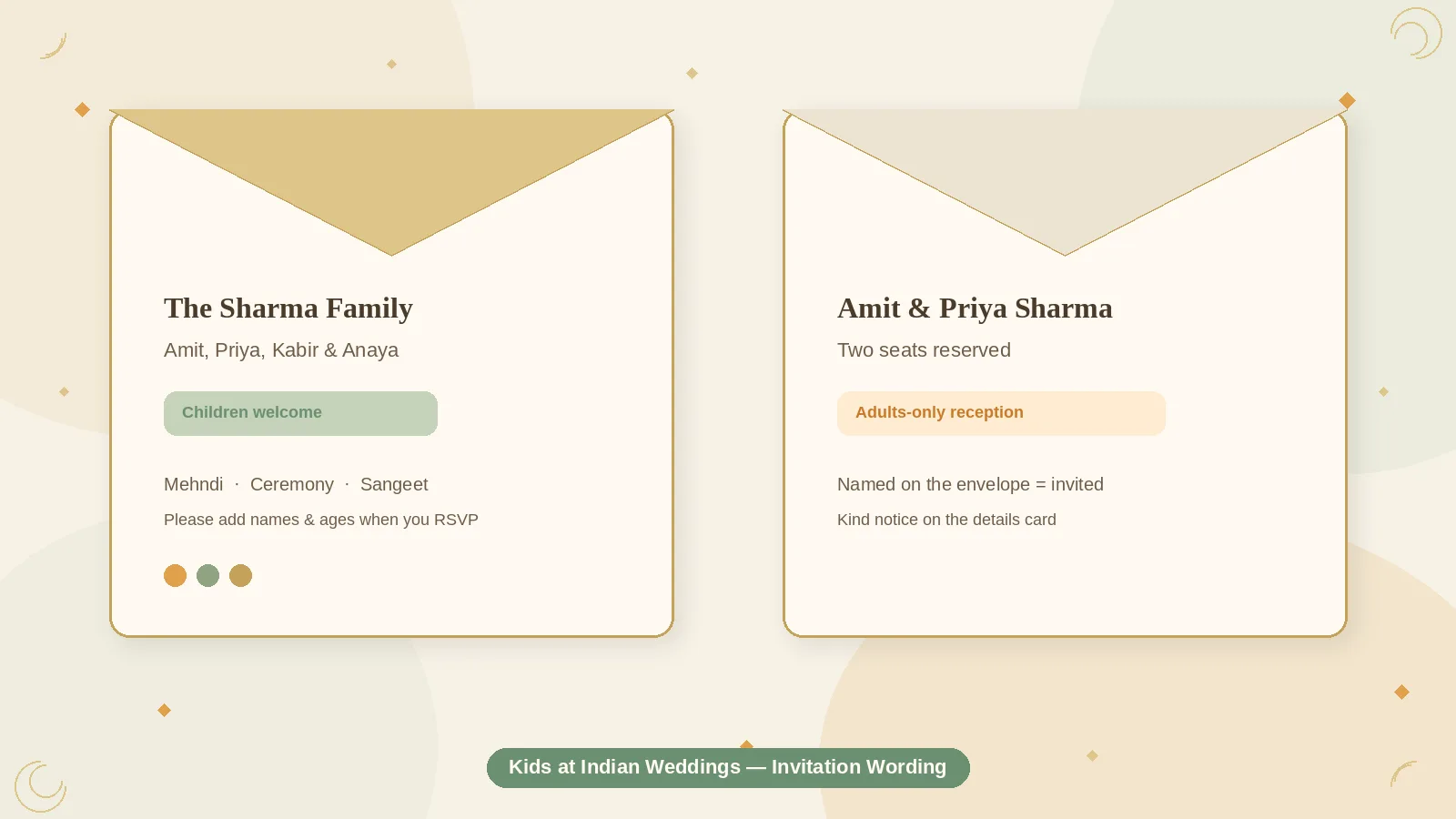
On many Indian invitations, the three words “and family” do more work than the rest of the card. Relatives read them as: spouse, children, sometimes the cousin staying in the house that week. If that is not what you mean, the invitation has to say so — kindly, early, and the same way for everyone you can.
This guide is about kids at Indian weddings: how to word the invitation, how to address the envelope or digital greeting, and the guest logistics that follow once children are coming — or once they are not. It is for couples and parents navigating joint-family expectations, friend circles used to adults-only receptions, and mixed weekends where the mehndi is child-friendly and the sangeet is not.
Why this is culturally loaded
Indian weddings are family events. Asking parents to leave children at home can be heard as asking the household to split. That reading is stronger with outstation guests, elders who travel with grandchildren, and families for whom a wedding is a rare gathering, not a party.
None of that means you must invite every child. It means you need a policy you can explain to both mothers, not a rule you invent at the gate.
Decide per function if your weekend is mixed. A blanket “kids / no kids” is simpler to print and harder to live with when the daytime ceremony is in a temple hall and the reception is a late hotel DJ.
Typical patterns that actually work:
- Children welcome at all functions
- Children welcome at daytime functions only (mehndi, ceremony, lunch)
- Adults-only evening events, with named exceptions (flower children, the couple’s nieces and nephews)
Exceptions will leak. If only one sister’s children are coming, tell other parents before the card arrives, not after they have booked a family room.
Start with who is named
Wording fails when the envelope says one thing and the group chat says another.
If children are invited
- Name them, or write “and family” / “and children” on purpose.
- Digital greetings can list: “Amit, Priya, Kabir and Anaya.”
- Adult children who live on their own should usually get their own invite, not a parent’s “and family.”
If children are not invited
- Address only the adults: “Amit and Priya Sharma,” not “The Sharma Family.”
- Do not rely on silence. In India, silence is often read as inclusion.
- Match the RSVP: seats reserved for two, not a blank “number attending.”
Western etiquette sometimes treats a missing child’s name as enough. For many Indian guest lists, it is not. Add a plain line on the details card or website.
Invitation wording that stays warm
Keep “no children” off the front of a formal card if you can. The card invites people in; the details line and FAQ carry the boundary. If your families need the line on the card to prevent surprise, keep it short and respectful.
Children welcome everywhere
- “We would be delighted to have you and your children with us for the wedding celebrations.”
- “Please bring Kabir and Anaya — kids are welcome at every function.”
Daytime yes, late sangeet or reception no
- “Children are welcome at the mehndi and the wedding ceremony. The sangeet is an adults’ evening.”
- “We would love to see the little ones for the pheras and lunch. Kindly note the reception is adults-only.”
Adults-only, with notice
- “We are hosting an adults-only reception and hope you can join us for an evening celebration.”
- “With love for your little ones, we have kept this function to adults so we can run a late programme. We hope you understand.”
- Website FAQ: “Are children invited? We adore them, and we are keeping [function] adults-only. Thank you for helping us plan seating and timing.”
What not to write
- “No kids allowed.”
- “Enjoy a night off!” — it assumes parents want one, and it can sound smug.
- Age cut-offs that read like a club policy (“no one under 12”) unless the venue truly requires it, in which case name the venue reason.
- Jokes about crying during the pheras.
If a venue or a sacred space has a real restriction, say so. “The mandap seating is limited, and we cannot accommodate strollers on the marble” is easier to hear than a vibe-based ban.
Collecting names and ages without sounding like a bouncer
You need children’s names for meals, seating, and welcome kits. You do not need a lecture.
On RSVP (a wedding website works well here — including guest pages in the LoveSolutions style):
- “Please add children’s names and ages so we can plan meals and seating.”
- “We have reserved [2] seats for your household.”
- Per function: “Mehndi — adults and kids; Sangeet — adults.”
If someone RSVPs four names on a two-seat invite, call once, privately, from the relative who has the relationship. Do not correct them in a group.
Logistics when children are coming
Wording without logistics is how parents spend the sangeet in a corridor.
Worth deciding and stating, briefly:
- Meals: a simple kids’ plate, or the same vegetarian thali in smaller portions. Note allergens if you already collect them.
- Timing: which functions run past bedtime. A 7 pm start that actually means 9:30 pm is the detail parents need.
- Helpers: whether a nanny or grandparent-helper needs a seat and a meal. If yes, say they are welcome; if the plate is not budgeted, say so early.
- Space: a quiet room at the hotel, a relative’s suite, or “no separate kids’ room — parents, please plan.” Honesty beats a fairy-tale crèche you will not staff.
- Safety: pools, fireworks, open havan flames, lawn bugs, stairs without rails. One sentence on the website is not overkill.
- Travel: outstation parents need to know if a family room is in the block.
You do not have to run an entertainment programme. You do have to avoid surprising people with a midnight fireworks display beside a row of sleeping toddlers.
Logistics when children are not coming
The kindest extra is time. If parents must arrange care, they need the news at save-the-date, not ten days out.
Be ready for some outstation parents to skip a destination function. That is a cost of the policy, not a failure of wording.
Do not surprise families at the door. Brief the hosts and the welcome desk. A relative arguing with a tired parent in the lobby will undo a polite card.
If you make exceptions for wedding-party children, say so in the FAQ in general terms: “Children in the wedding party and our nieces and nephews will be with us; we could not extend that to every household.” Then make the private calls.
A wording-and-logistics checklist
- [ ] Per-function decision is written down (not “we’ll see”)
- [ ] Envelope / digital names match the policy
- [ ] “And family” is used only when you mean it
- [ ] Details card or website states the rule in one warm paragraph
- [ ] RSVP captures children’s names (or seat count) per function
- [ ] Exceptions are named early and privately
- [ ] Parents of outstation kids were told at save-the-date if care is required
- [ ] Meals, helpers’ plates, and late-night reality are stated
- [ ] Welcome desk knows the policy
- [ ] The card, the website, and the aunties’ WhatsApp say the same thing
Common mistakes
- Using “and family” as decoration. It is a guest-list decision, not a flourish.
- Adults-only on the website only. Many elders never open the site.
- Different rules for “our side” leaked late. Apply what you can evenly; explain what you cannot.
- No seat count. Blank RSVPs are how extra children appear.
- Ignoring helpers. In many homes, a child does not travel without an adult who is not on your pretty envelope.
FAQ
Is it rude to host an adults-only Indian reception?
It is allowed. It is ruder to spring it at the door. Clear names, early notice, and a matching website line are the difference between a boundary and a snub.
Should children’s names go on the printed card?
If they are invited and you have space, naming them feels personal. If the list is long, “and family” plus named children on the RSVP page is enough.
What about infants?
Decide explicitly. “Adults-only except infants in arms” is a real policy — and still needs a quiet space if the function is long. Do not assume parents will know your preference.
How do we word a mixed weekend?
Use function names, not a mood. “Kids are welcome at mehndi and the wedding; the sangeet is adults-only” is clearer than “family functions and party night.”
Closing thought
Children at Indian weddings are not a styling choice. They are a household decision that shows up on the envelope, the RSVP, the thali count, and the late-night corridor. Choose a policy you can keep, write it in warm plain language, and make the rest of the weekend match the card. Parents can then plan — which is the actual hospitality.