Indian weddings rarely ask one invitation to do one job. The same weekend may include a quiet mehndi, a loud sangeet, a sacred ceremony, and a reception where colleagues finally meet cousins. Guests live in different cities — sometimes different countries — and they do not all open information the same way.
That is why the useful question is rarely “print or digital?” It is which channel carries which job — and how those channels work together without confusing the people you love.
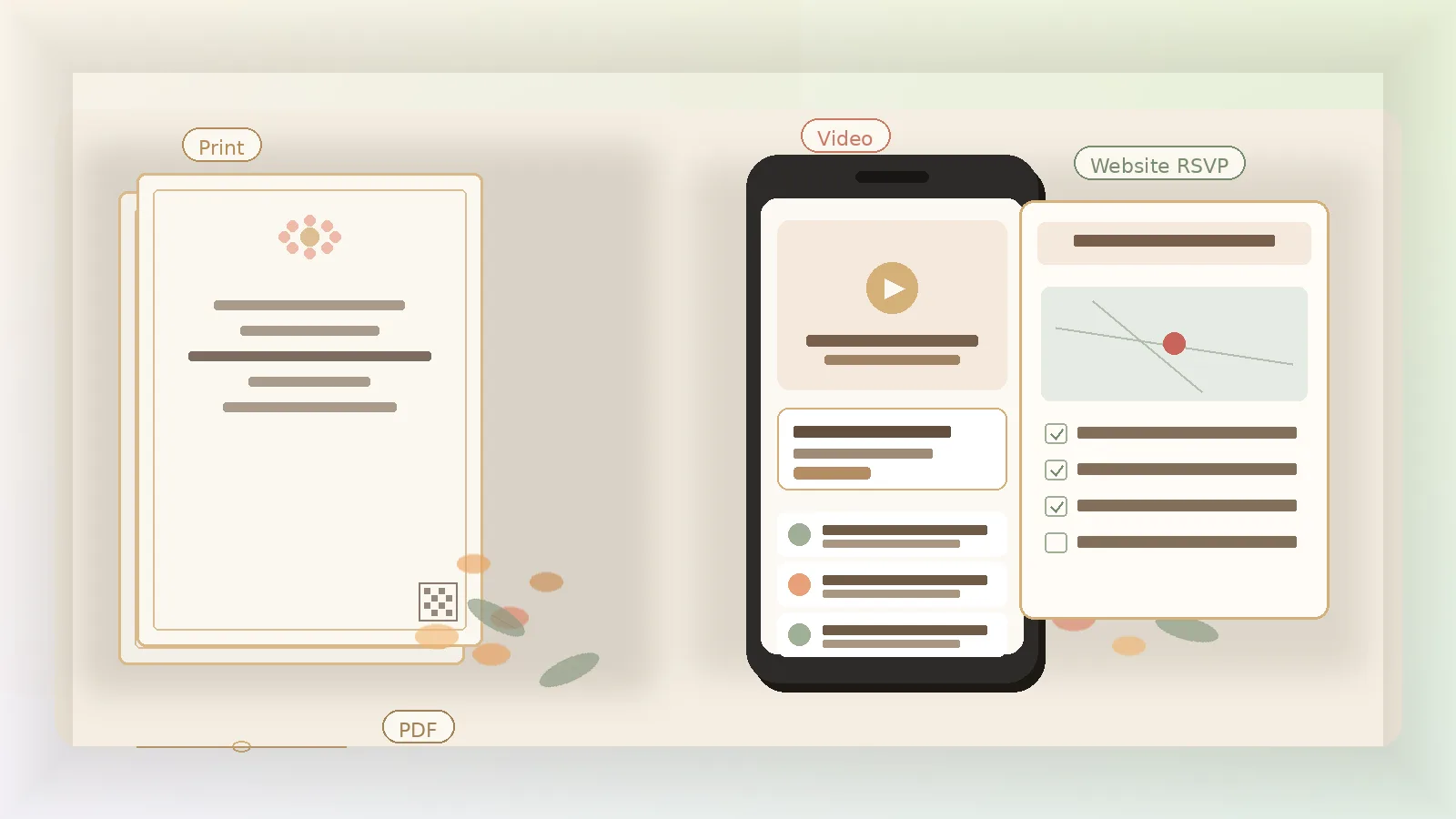
This guide is for couples and families planning multi-function weddings in India (including celebrations with NRI guests). It covers when print still matters, when a PDF is enough, when a WhatsApp video invite shines, when a mobile wedding website becomes the backbone — and how to combine them without breaking guest experience.
The hybrid mindset: one story, four tools
Think of invitations as a small system, not a single object.
| Channel | Best at | Weak at |
|---|---|---|
| Printed card | Respect, keepsake, formal feel, elders who prefer paper | Fast updates, per-function RSVP, maps that change |
| PDF / static e-card | Clean shareable “card” look, easy forward, print-at-home | Long schedules, live RSVP, rich travel detail |
| WhatsApp video invite | Emotion, announcement energy, attention in family chats | Full logistics, RSVPs, edits after sending |
| Wedding website + RSVP | Schedule, maps, dress notes, per-function replies, one source of truth | Replacing a warm personal delivery moment on its own |
A strong hybrid plan usually picks one emotional opener (print, PDF, or video) and one living hub (a mobile website) that holds details guests will check more than once.
When print still matters
Print is not outdated in India. It is selective.
Print still earns its place when:
- Elders and formal hosts expect a card they can hold, show relatives, and place on a table.
- The ceremony or reception needs a traditional “this is official” feeling — especially for close family and VIPs.
- You want a keepsake for parents and grandparents, not just a forwardable file.
- Some guests are less comfortable managing long digital threads (or share one family phone).
Practical approach: Print a smaller, intentional batch — often for elders, close family, and anyone hosting a function — rather than reprinting the entire social circle. Pair the card with a QR code or short URL that opens the wedding website for maps, schedule, and RSVP. The card carries respect; the link carries logistics.
Avoid printing every last detail if venues or timings may still shift. Paper does not update itself.
When a PDF wedding invitation shines
A well-designed PDF (or high-quality static e-card) sits between print and full digital systems.
PDF works best when you need an elegant, forwardable “card”; a print-at-home option without a full print run; a consistent visual across WhatsApp, email, and a few local print copies; or a mixed guest list that wants paper and files — without live RSVP inside the file itself.
Keep PDFs guest-friendly: modest file size (so WhatsApp does not blur it), function names/dates/cities/website link above the fold, and one canonical PDF — not five versions with conflicting timings.
A PDF is excellent as a portable invitation card. It is usually a weak place to collect RSVPs or host travel instructions that change weekly.
When WhatsApp video invites win
For many Indian families, WhatsApp is where attention already lives. A short wedding video invite can create joy that a static card cannot.
Video tends to win when:
- You want a warm announcement friends and cousins will watch and forward.
- Names, dates, cities, and a blessing line can sit on screen (many people watch without sound).
- You are inviting a younger or highly digital circle — or NRI guests who need something personal without courier delay.
Keep video in its lane. A beautiful video is usually the invitation moment, not the information system. Guests should not scrub a clip to find the sangeet address or reception dress code.
Guest-experience rules: keep the file phone-friendly; put essentials on screen; end with a clear next step (“Full schedule & RSVP: [link]”); prefer broadcast-style personal delivery over one chaotic invite-only group.
Soft note: platforms built for Indian weddings (including tools in the LoveSolutions space) often pair WhatsApp-friendly video or card formats with a shareable hub — useful when emotion and logistics need to travel together.
When a mobile wedding website / RSVP is the backbone
If print, PDF, and video are how you arrive, the website is how guests stay oriented.
A wedding website earns backbone status when you have multiple functions, venues, or dress codes; outstation and NRI guests need maps and hotel notes; you want per-function RSVP instead of a vague “haan aa jayenge”; or details may still change and you refuse to re-send five corrected PDFs.
What the hub should hold (at minimum):
- Function-wise schedule with venues and cities
- Stable maps / pin links
- Dress or colour notes if they matter
- Travel / stay pointers for outstation guests
- Clear RSVP — ideally by function, with headcount and simple meal notes where catering needs them
- One contact for genuine questions (a family liaison, not twelve chat threads)
This is also where soft digital RSVP tools help: one link, fewer “please reply on this chat” follow-ups, and less spreadsheet archaeology before catering locks.
Hybrid playbooks you can copy
Adjust these for your families — not every wedding needs all four channels.
Playbook A — Elders + friends + logistics (most common)
- Print for grandparents, elderly aunts/uncles, and formal hosts
- WhatsApp video for friends, colleagues, and cousins
- Website + RSVP as the single source of truth for everyone
- Optional: PDF for anyone who wants a forwardable card without video
Playbook B — Destination / NRI-heavy guest list
- Early save-the-date (PDF or short video) with city and dates
- Website live early with travel and hotel notes
- Closer in: refined video or PDF as the emotional invite
- Keep RSVP deadlines realistic for flight bookings
Playbook C — Intimate rituals, larger reception
- Smaller print or personal PDF for ceremony/mehndi circles
- Wider video + website for reception guests
- Tag invitations so reception-only guests are not pulled into every ritual timing
Playbook D — Low-print, high-clarity
- Skip large print runs
- One strong PDF + video pair for delivery
- Website carries schedule/RSVP; QR on any small printed set for parents
In every playbook, decide one canonical schedule. If the video says 7:00 and the website says 7:30, guests will trust neither — they will call your parents.
Guest-experience pitfalls (and how to dodge them)
1. Broken WhatsApp previews — A bare link or a random login thumbnail looks unfinished. Test the share on a phone first.
2. Huge video files — If the invite crawls on mobile data, many relatives never finish it. Compress thoughtfully; park the full story on the website.
3. Missing per-function details — “Wedding this weekend in Jaipur” is not enough when mehndi, pheras, and reception are in three places. Each invite should clarify which functions apply.
4. No single source of truth — When aunties edit the PDF, cousins forward an old video, and the group invents a new timing, chaos wins. Publish updates on the website first, then notify once.
5. RSVP only in chat replies — Scattered “+2 veg” messages are hard to tally across functions. A simple form or wedding-site flow usually beats archaeology — even if a liaison helps elders reply by phone.
6. Household assumptions — In India, one invite often represents a household. Say clearly whether children, spouses, or accompanying elders are included.
Practical checklist before you hit send
- [ ] Primary emotional channel (print / PDF / video) + hub (website) chosen
- [ ] Print batch intentional — elders / hosts / keepsakes — not “everyone” by default
- [ ] Video phone-friendly; names/dates/city readable without sound
- [ ] PDF or card includes website link or QR
- [ ] Website lists every function with venue, city, and timing
- [ ] Guests know which events they are invited to
- [ ] RSVP asks for headcount (and meal notes if needed)
- [ ] One person owns updates so timings do not fork
- [ ] NRI / outstation guests can find travel and stay notes
- [ ] WhatsApp share preview and RSVP form tested on mobile data
Soft path if you want invite + RSVP in one flow
If you prefer not to stitch five tools together, look for invite experiences that already combine a shareable card or WhatsApp-friendly format, a PDF option for elders, and a mobile page with schedule plus RSVP. LoveSolutions focuses on that kind of guest communication for Indian families — useful when you want hybrid delivery without building the stack from scratch. Choose whatever keeps your guests clear and your hosts calm.
Short FAQ
Do we still need printed invitations if everyone is on WhatsApp?
Not for everyone. Many families still print for elders and formal hosts, then go digital for the wider list. Respect and practicality can share the same plan.
Is a video invite enough on its own?
Rarely, for multi-function weddings. Video is excellent for emotion and announcement. Put schedule, maps, and RSVP on a website guests can reopen.
PDF vs wedding website — which should we prioritise?
If you can only do one well: prioritise the website for logistics and replies, and use a simple PDF or video as the delivery wrapper. If elders need paper, print a small set from the same design system.
How early should we share digital invites?
Earlier for destination and NRI-heavy lists; closer for local guests if details are still settling. Lock a date when the website becomes the update channel.
What about guests who will not RSVP online?
Assign a family liaison. Digital RSVP can still be the system of record while someone helps elders reply by phone — then updates the form once.
Hybrid wedding invitations in India work best when each format does the job it is good at: print for honour and keepsake, PDF for a clean shareable card, video for warmth, and a website for clarity. Choose the mix that fits your functions and families — then protect one source of truth so every guest arrives informed, not confused.