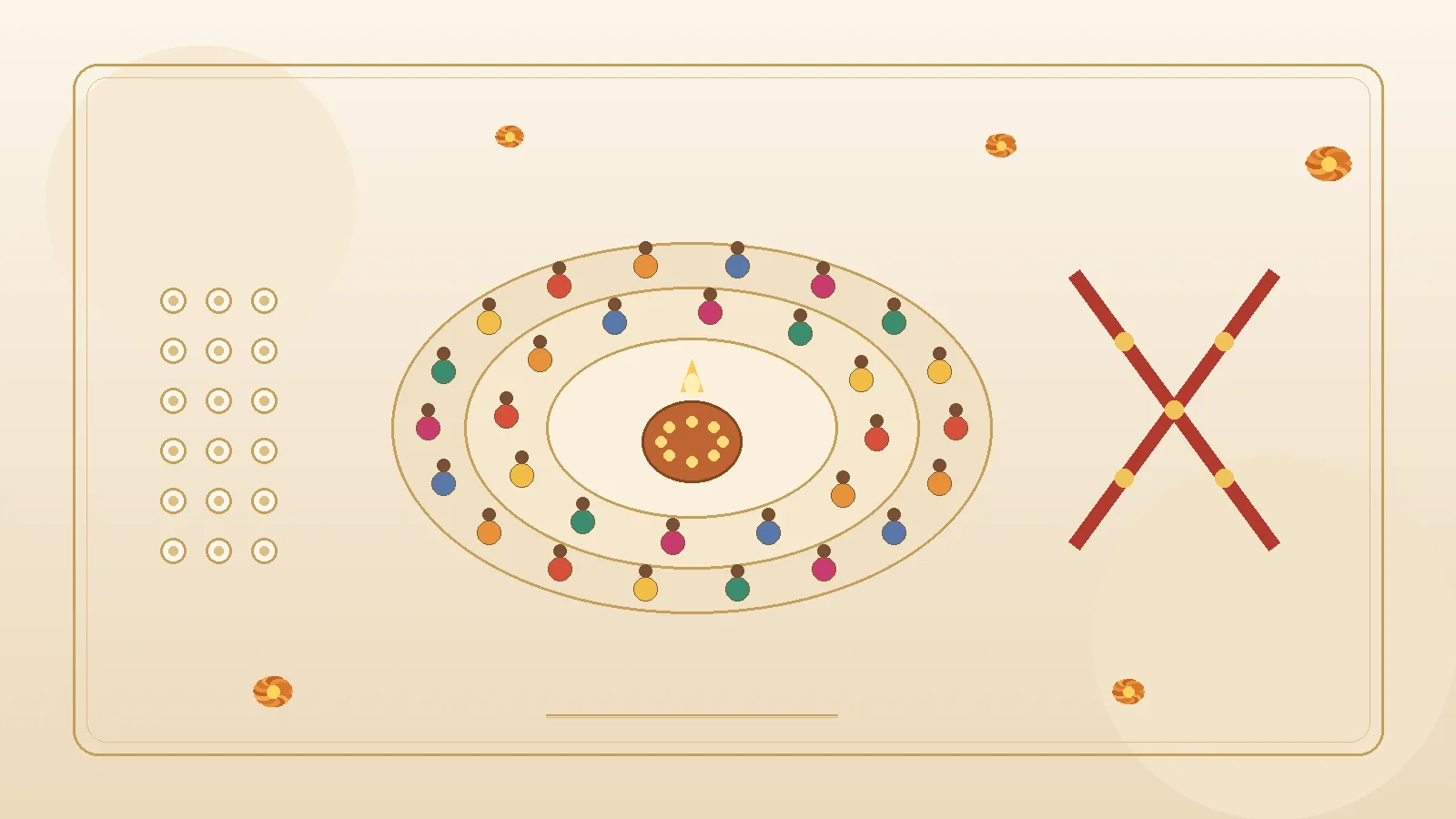
Navratri 2026 runs from 11 to 19 October, and for nine nights families across India will be in garba circles, swapping dandiya sticks and arguing over the best tran taali. Then, a few weeks later, the winter wedding season begins. It is no surprise that so many couples want that same energy at their sangeet: a circle that pulls everyone onto the floor instead of a stage that keeps them in their seats.
The catch is that a wedding crowd is not a Navratri crowd. Half your guests may never have played garba, the groom's college friends may be meeting a dandiya stick for the first time, elders want to join for one song and sit for the next, and the venue has a sound cut-off. A garba night sangeet works when it is planned for participation, not just decorated for it.
This guide covers choosing a format, setting up the floor so beginners join, handling dandiya sticks safely, pacing for elders, a sample run-of-show, and exactly what to tell guests on the invite and wedding website. It is not a décor mood board, a general sangeet planning guide, or a multi-function dress-code page.
Why garba sangeets are trending this season
The timing explains much of it. The Times of India's Navratri 2026 calendar, published on 2 October, puts Shardiya Navratri from Sunday 11 October to Monday 19 October, with Vijayadashami on 20 October. City listings compiled by HI TEA on 3 October show how varied the 2026 garba and dandiya scene has become, from singer-led traditional circles in Vadodara and Ahmedabad to hotel ballroom nights, disco dandiya formats and family-friendly resort evenings.
Wedding planners are carrying that into sangeets. Brothers Events, an Ahmedabad decor firm, wrote in April 2026 about "Neon-Garba" sangeets that pair garba with LED and kinetic lighting. Shaandaar Events' Navratri decoration ideas for 2026 suggest turning a sangeet into a dandiya night with wooden dandiya sticks as favours and mirror-work stage backdrops. Delhi NCR decorators such as The Fusion Decor promote garba-inspired dance floors with concentric dance circles marked out on lawns.
Underneath the lighting trend is something older. UNESCO inscribed the Garba of Gujarat on its intangible cultural heritage list in 2023, describing a communal circle dance rooted in devotion to the goddess. That matters for hosts: a garba night is a living tradition, not just a theme. The best ones respect that while welcoming everyone.
Choose the format first
Different formats suit different families and guest lists. Decide this before you brief the DJ or decorator.
| Format | What it looks like | Best for |
|---|---|---|
| Full garba night | The whole sangeet is garba and dandiya, with live singers or a garba DJ and food in between rounds | Gujarati or garba-loving families, guests who already play |
| Garba segment inside the sangeet | A 45-60 minute garba block, then family performances, then open dancing | Mixed crowds; the most common choice |
| Garba opener | Aarti and a short traditional garba to open the evening, then a regular sangeet | Families who want the devotional touch without a full night |
| Bollywood or fusion garba | Garba steps to popular Hindi film tracks, often with a teach-in | Young crowds and guests new to garba |
If the family wants the devotional dimension, begin with a short aarti before the first circle, with an image of the goddess or a decorated garbo (lamp pot) at the centre. Keep it brief and explain it in one line for guests unfamiliar with it. If your family prefers a purely celebratory evening, that is fine too; just avoid dressing up devotional elements purely as props.
Set up the floor so beginners actually join
The most common failure at garba sangeets is a circle of twenty confident dancers surrounded by a hundred spectators. These steps fix that.
- Mark concentric circles. An inner circle for beginners and slower steps, an outer circle for experienced dancers moving faster. Tape, rangoli-style floor wraps or lighting can mark them. Guests self-sort without being told they are beginners.
- Run a short teach-in. Ten to fifteen minutes before the main garba, have a choreographer, a confident cousin or the singer's team teach two or three basic steps, such as the two-clap and three-clap garba. Announce it in advance so nervous guests know they will not be thrown in cold.
- Ramp the tempo. Start slow, then build. Garba singers and good garba DJs do this naturally; brief yours that the first round is for everyone.
- Use "anchors". Ask a handful of family members who know the steps to spread out around the inner circle so newcomers can follow someone nearby.
- Keep a clear path out. Guests should be able to step out of the circle without crossing it, especially elders and children.
Live singers or a garba DJ?
Both work; they create different nights.
- Live garba singers and a small band bring the traditional feel, respond to the floor in real time, and naturally pace rounds from slow to fast. They suit families who want the evening to feel close to a Navratri circle.
- A garba-specialist DJ can blend traditional garba, Bollywood garba and dandiya tracks, then move smoothly into the open-dancing part of the sangeet. They suit mixed crowds and later-night energy.
- A hybrid is common: a live dhol player alongside the DJ, or live singers for the first hour and a DJ afterwards.
Whichever you choose, brief them on three things: the teach-in slot, a slow first round for everyone, and the hard stop time at the venue. Ask them to include a few songs elders will recognise and to announce every switch from garba to dandiya.
Dandiya sticks: provide, protect, collect
Dandiya raas brings sticks into a crowded floor, which is joyful and occasionally painful.
- Provide sticks at the entry to the dance area rather than expecting guests to bring their own. A basket or stand with pairs ready to pick up works well.
- Offer lighter sticks for children and keep heavy decorative sticks for display or favours.
- Separate dandiya from seating. Elders' chairs should sit a little back from the dandiya floor, not on its edge.
- Announce the switch. When the music moves from garba (no sticks) to dandiya raas (sticks in pairs), let the MC or singer announce it, so guests can pick up or put down sticks.
- Collect them. Place bins at exits, or tell guests clearly if the sticks are theirs to keep as favours.
Pace the night for elders and non-dancers
A great garba sangeet lets an elder join for one song and rest for the next without feeling left out.
- Place a ring of comfortable chairs with a clear view of the circle, close enough to feel part of it.
- Plan short breaks between rounds, with water and light snacks nearby.
- Ask the singer or DJ to include a few slower traditional songs that elders know, especially early in the evening.
- Invite elders into the first slow round personally. One grandparent stepping in often brings an entire row of aunties with them.
A sample run-of-show
Adjust to your venue, but a mixed-crowd sangeet might look like this:
| Time | Segment |
|---|---|
| 7:30 PM | Guests arrive, welcome drinks, sticks available at the dance-floor entry |
| 8:00 PM | Short aarti (optional) and the first slow garba round |
| 8:15 PM | Teach-in for beginners |
| 8:30 PM | Open garba, tempo building |
| 9:15 PM | Dinner opens |
| 10:00 PM | Family performances |
| 10:45 PM | Dandiya raas and Bollywood garba until the sound cut-off |
Check the venue's sound cut-off before you print anything. The Noise Pollution (Regulation and Control) Rules, 2000 restrict loudspeakers and public address systems at night, from 10 PM to 6 AM, except in closed premises such as banquet halls, with limited festival-time relaxations decided by state authorities. Many open-lawn venues enforce early cut-offs as a result, so plan your highest-energy segment for when the music can actually play.
What to wear and what to put on your feet
Guests will ask, so answer in one calm line rather than a full dress code. Chaniya choli, kediyu and festive kurtas are lovely and entirely optional. The real guidance is practical:
- Wear something you can twirl in. Very heavy lehengas and long trains are hard to dance in for an hour.
- Footwear matters more than outfits. Flats, juttis or clean sneakers work on most floors. If your venue has a carpeted or padded garba area where guests dance barefoot, say so and arrange a shoe rack nearby.
- Pin dupattas. A quick line suggesting guests pin or tie dupattas saves tangles in the circle.
What to tell guests on the invite and website
Keep the invitation line short and let the wedding website carry the detail.
Invite one-liner:
"Sangeet and Garba Night, Friday 4 December, 7:30 PM. No experience needed; we'll teach you the steps."
Website Guest Info or FAQ:
Garba Night (Sangeet) We're opening the sangeet with garba and dandiya. Never played before? Join our short teach-in at 8:15 PM; the inner circle is for beginners and slower steps. Dandiya sticks will be provided at the dance floor. What to wear: anything festive you can move in. Chaniya cholis and kurtas are welcome but not required. Comfortable flats or sneakers are best. Elders and children: seating is close to the circle, and the first rounds are slow. Timing: dandiya and open dancing continue until 11:30 PM, when the venue's music ends.
Swap in your venue's real cut-off; the 11:30 PM above assumes an indoor banquet hall.
A wedding website or digital invite hub, such as those LoveSolutions builds, is a natural home for this kind of note. It is easy to update if the teach-in moves or the venue changes the cut-off, and guests can check it on their phones on the way.
Make everyone feel welcome in the circle
Many sangeets now include guests from other states and countries who have never seen garba. A few gestures help:
- Ask the MC to explain garba in two sentences before the teach-in: what it is, why it moves in a circle, and that everyone is welcome.
- Pair newcomers with a friendly family member for the first round.
- Never single out a beginner for a spotlight moment unless they have clearly volunteered.
- Ask guests to step out of the circle before filming, so the dance keeps moving.
Quick answers
Can we hold a garba sangeet if we are not Gujarati? Yes. Garba is widely celebrated across India and by diaspora communities. Approach it with respect, involve someone who knows the steps, and enjoy it.
Is it appropriate to do garba outside Navratri? Garba and dandiya are a familiar part of many wedding celebrations, especially in Gujarati families. If you include devotional elements like an aarti, treat them with the same respect you would during Navratri.
What is the difference between garba and dandiya? Garba is danced in a circle with hand claps and turns; dandiya raas is usually danced in pairs or lines striking decorated sticks. Most sangeets include both.
Closing
A garba night sangeet is one of the few wedding traditions where every guest can be in the celebration rather than watching it. Choose a format that fits your family, mark circles that make room for beginners, teach a few steps, handle sticks safely, pace the night for elders, check the sound cut-off, and tell guests clearly what to expect. Do that, and this season's Navratri energy will be in your circle too.