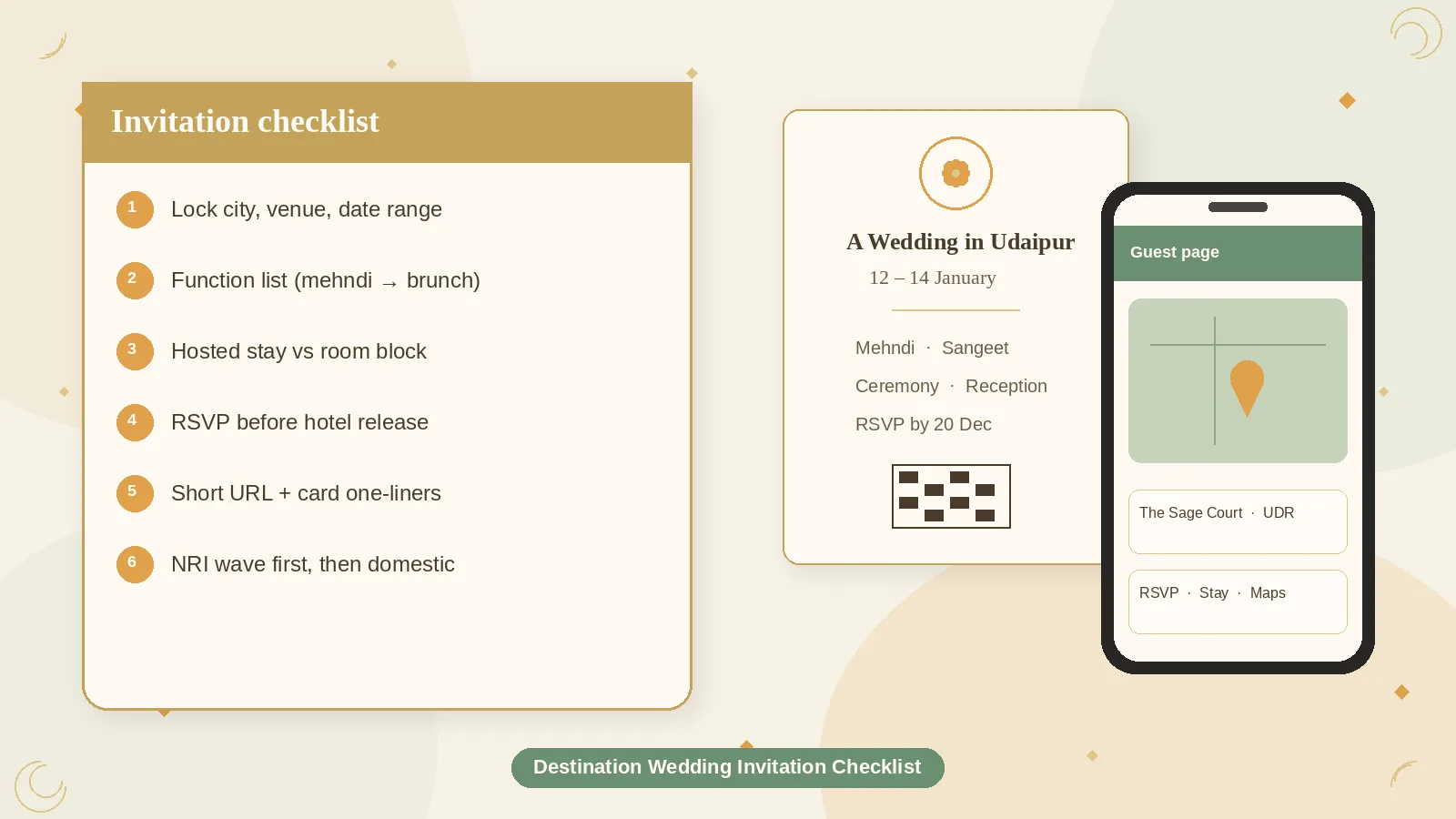
A hometown invitation can arrive late and still work. A destination wedding invitation cannot. Guests need the city, the dates, and a clear reason to book leave and flights before they care about foil on the card.
This destination wedding invitation checklist for India is for couples hosting a multi-function celebration away from home — Udaipur, Jaipur, Goa, Kerala, a hill station, or an overseas resort — and for families inviting a mix of people who already live near the venue, relatives travelling across India, and NRI guests.
It is not a full weekend run-of-show. It is the invitation job: what to lock, what belongs on the card, what belongs behind a link, and when each wave should go out.
Destination invites do a different job
At a city wedding, many guests already know the hall, the usual hotels, and whether they can drop in for one function. At a destination wedding, the invitation is also a travel decision. If the card is beautiful but silent on city, dates, and how to confirm, guests wait. Waiting is how room blocks leak and a Friday mehndi looks empty.
Treat the invitation as three layers:
- The announcement — couple names, families, destination, date range
- The commitment ask — who is invited to which days, RSVP by when
- The living details — maps, dress notes, shuttles, room codes — on a page you can still edit
The card or first WhatsApp message should carry layers 1 and 2. Layer 3 belongs on a page you control.
Lock these before you design anything
Do not send a destination invitation on “almost final” dates. Guests book fares they cannot cheaply change.
Lock:
- City and venue name (resort, palace, hotel) — or at least the city if the property is still under embargo
- Date range guests should travel for, not only the pheras day
- Which functions exist — mehndi, sangeet, ceremony, reception, farewell brunch — using the names your families actually use
- Who is hosted versus who self-arranges stay, even if you phrase it gently
- An RSVP deadline that sits before hotel release dates and catering guarantees
- One canonical short URL that will not change after print
If the venue or the “who pays for rooms” decision is still a family argument, pause the invite. “Details to follow” is acceptable on a save-the-date. It is stressful on a formal invitation.
Timeline: save-the-date, then invitation, then updates
| Guest type | Save-the-date | Formal invitation | Details page ready |
|---|---|---|---|
| NRI / overseas | 6–8 months out (passports, visas, leave) | 10–14 weeks out | With the invite, then refined |
| Domestic outstation | 4–6 months out | 8–10 weeks out | With the invite |
| Guests already in the destination city | Optional | 4–6 weeks out | With the invite |
These are planning windows, not laws. The principle is simple: the farther the guest, the earlier the first signal. A save-the-date can be city + dates + “invitation to follow.” The formal invite should not be the first time an uncle in London hears the city.
Set the RSVP date against operations, not against when the designer is free. If the resort needs names 21 days out, your public reply date should be earlier, so you have time to chase.
What belongs on the invitation itself
Keep the card — print or digital — readable in about twenty seconds:
- Hosts and couple names
- “A wedding in [City]” plus the date range
- Venue name and city/state
- Function names with dates (add times only if they are truly locked)
- RSVP by [date] and how (link, scan, or a named contact)
- A short URL under any QR code
- One line on stay: “Rooms reserved at [Hotel]; see the link for booking notes”
Useful if space allows:
- Nearest airport code (UDR, GOI, JAI, COK) — people search flights by code
- “You are invited to [functions]” if that household is not on every event
Do not try to print shuttle loops, packing lists, or timings you already know might move. Those details age badly on paper and in screenshots.
What belongs behind the link, not on the card
A mobile wedding website — the kind of guest page LoveSolutions and similar tools are built for — is the right home for:
- Per-function start times once they firm up
- Map pins and gate notes
- Hotel block code, cut-off, and who pays what
- Dress notes per function
- Airport or station guidance
- Contacts with roles
- Kids, plus-one, and gift notes
The invitation’s job is to get guests to commit and click. The page’s job is to answer the second wave of questions without another long family thread.
Addressing: who is actually invited to the destination
Destination weekends collapse when “and family” is assumed and the resort is priced per head.
On the envelope or digital greeting, name the people you are hosting. If children are invited, say so. If a household is invited only to the reception day, say so on their version of the invite — not in a public group.
Two versions of the invitation are normal:
- Full weekend — for guests you want from the first function through the last
- Ceremony / reception only — for guests who should not book a three-night stay
Same city and same dates on both. Different “you are invited to” lines. Never different cities.
Stay, money, and the sentence people actually need
Guests will not ask the awkward question first. Put a plain sentence on the details page, and a hint on the invite:
- “Stay is hosted at [Hotel] for [nights]; please RSVP so we can share your name with the front desk.”
- “We have a room block at [Hotel] under [code] until [date]. Guests book and settle their own rooms.”
- “A few rooms are hosted for elders and outstation family; others please see suggested hotels on the website.”
Ambiguity here creates more offence than a clear, kind line.
NRI extras without writing a visa essay
On the details page linked from the invite:
- A passport-validity reminder (many countries want six months’ remaining validity)
- That legal marriage paperwork is the couple’s job unless a guest is a named witness
- Currency, local SIM, and weather in one short paragraph
- That function times are in IST
Do not put visa advice you are not qualified to give. Point to official sources. The invitation should flag that travel documents take time, not impersonate an immigration consultant.
A practical destination wedding invitation checklist
Before design
- [ ] City, venue, and date range locked
- [ ] Function list locked
- [ ] Hosted vs self-pay stay decided
- [ ] RSVP deadline set before hotel and catering cut-offs
- [ ] Short URL chosen and tested on a phone
On the invite
- [ ] Names, city, dates, venue
- [ ] Function dates (times only if stable)
- [ ] RSVP method and date
- [ ] Typed URL (and QR if you use one)
- [ ] Stay one-liner
- [ ] Airport code if it helps
Send plan
- [ ] NRI save-the-date out first
- [ ] Domestic outstation next
- [ ] Local-to-destination last
- [ ] Full-weekend and one-day versions do not contradict
- [ ] One follow-up path for non-responders — not daily group reminders
After send
- [ ] Details page matches the card
- [ ] Hotel names and codes still true
- [ ] A named person owns guest questions
Mistakes that quietly break destination RSVPs
- Sending the pretty card before the city is real. Guests screenshot it. You cannot unscreenshot a city.
- One yes/no for a four-day weekend. You need a yes per function, or at least “full stay vs Sunday only.”
- No typed URL. QR-only cards fail in dim light and with guests who will not scan.
- Different dates in the video, the card, and the chat. Align once, then freeze.
- An RSVP date after the hotel release. You will be confirming rooms you no longer hold.
FAQ
How early should we send destination wedding invitations in India?
Save-the-dates for people who must fly: often 6–8 months. Formal invitations: commonly 8–12 weeks before the first function, earlier for overseas guests. People already in the destination city can receive the card later.
Should start times go on the printed destination card?
Only if they will not move. Dates and city matter more than “7:30 pm sharp” printed eight weeks out. Put firming times on the website.
Do we need a separate information card?
A small insert is useful if you want elders to hold a URL and a hotel name. Keep changeable logistics on the live page the insert points to.
What if some guests already live in the destination city?
Invite them with the same dates and venue. Skip the travel essay. They still need RSVP, dress notes, and whether they are on every function.
Closing thought
A destination wedding invitation is a travel decision wrapped in a greeting. Lock the city and dates, name who is invited to which days, put a real RSVP deadline on the card, and keep the rest on one link you can still update. That is the checklist that matters — not a longer poem on the envelope.