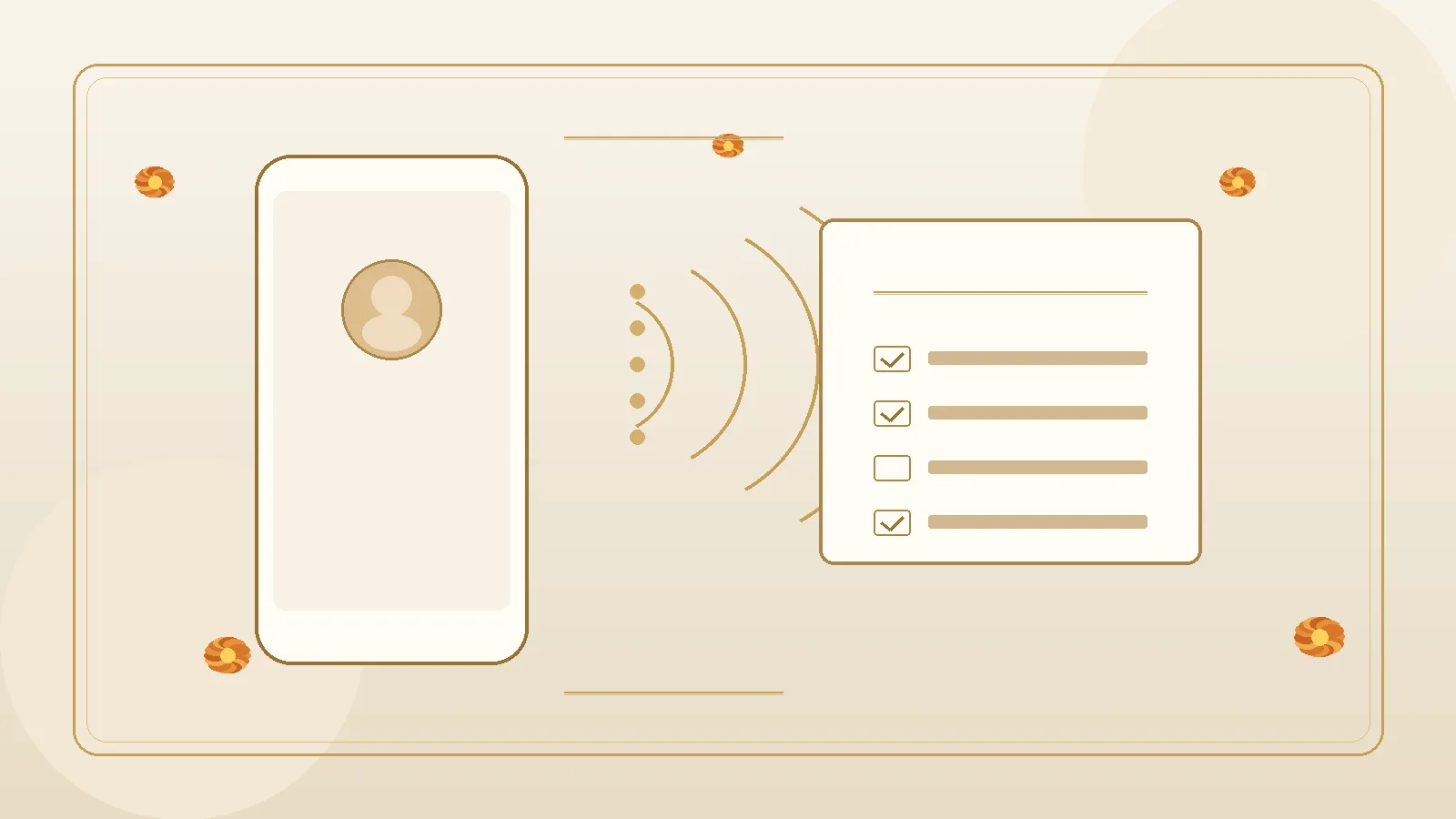
WhatsApp invites went out three weeks ago. Half the guest list replied in a day. The other half — elders who open messaging twice a month, an uncle across three time zones, dadaji's bank friend who only answers calls — still sits in "no response." The caterer wants numbers. Someone suggests calling everyone manually. Someone else has heard that an AI voice RSVP Indian wedding 2026 workflow can dial non-responders, ask attendance and dietary questions in Hindi or English, and write answers back to a dashboard.
This piece is a practical read on what voice AI actually does for RSVP collection in Indian multi-function weddings, how it differs from a one-way voice broadcast, when WhatsApp still wins, when a human should still place the call, and why your wedding website or digital invite hub should remain the system of record. It is not a review of every vendor, not a claim that voice replaces hospitality, and not a remix of broader "where AI helps guest communication" guides. Qualitative product patterns below draw on publicly described Weddingkart Voice AI and related feature pages — treat platform throughput and price figures as platform-reported, not as verified industry-wide facts.
The RSVP gap voice is trying to close
Large Indian weddings still hit the same wall: digital channels work brilliantly for guests who live on WhatsApp, and stall for guests who do not. Families then invent parallel systems — a nephew calling twenty numbers, a printed list on the dining table, conflicting "haan" messages in three groups.
Voice AI enters as a capture channel, not as the wedding's brain:
- Outbound voice AI dials selected guests (often non-responders), runs a scoped two-way conversation, and extracts attendance, headcount, and dietary preference
- Inbound voice AI (still maturing in regional languages) can answer helpline-style FAQ calls for guests who prefer speaking to typing
- Results should land in the same guest record used for WhatsApp RSVPs and website RSVPs — otherwise you create a fourth spreadsheet
Use voice where WhatsApp stops working. Do not rip out one-tap buttons for guests who already reply in seconds.
Voice AI vs Voice Broadcast (do not confuse them)
Product pages that sell both features usually draw a clean line. Weddingkart's Voice Call / Voice Broadcast materials describe one-way recorded audio that plays when a guest picks up — useful for a baraat timing change, an elder's blessing in their own voice, or a thank-you message. Voice AI is two-way: the agent listens, answers scoped questions, and captures structured RSVP fields.
| Situation | Voice Broadcast (one-way) | Voice AI (two-way) |
|---|---|---|
| Elder blessing in dadaji's own voice | Strong fit | Not needed |
| Last-minute venue or timing announcement | Fast one-way reach | Possible, but overkill if no reply needed |
| Confirm RSVP + headcount + dietary | Cannot collect replies | Designed for this |
| Guest asks "Sangeet or main day?" mid-call | Recording cannot adapt | Scoped agent can clarify |
| Under-40 guests already on WhatsApp | Prefer WhatsApp | Prefer WhatsApp |
If your family only needs "please arrive by 6:30," a broadcast or WhatsApp may be enough. If you need "yes, four people, Jain," you need a conversation channel — Voice AI, a human call, or a structured form.
What a typical outbound Voice AI RSVP flow looks like
Public Weddingkart Voice AI descriptions (feature page updated around April 2026; companion blog on AI voice agent RSVP collection) outline a pattern many Indian platforms are converging on:
- Brief the agent in plain language — confirm attendance for [date/functions]; ask dietary preference; mention venue if asked
- Select a segment — non-responders after N days; bride's-side elders; NRI list; exclusions for people who must get a human call
- Parallel outbound dialling — calls go out in batches rather than one-by-one on a coordinator's phone
- Scoped conversation — name the couple, ask attendance, headcount, dietary; answer simple venue/timing questions from configured wedding details
- Write-back — yes/no/maybe, count, preference, transcript/summary to the same dashboard as other RSVP channels
- Retry logic — busy / no-answer retries on a schedule; voicemail fallback that names who the call was about; human flag after max attempts
The agent is positioned as a polite coordinator, not a robocall: it listens, handles interruptions, and keeps the script narrow. Open-ended chat that tries to negotiate seating drama or family politics is exactly where these systems should stop.
What Weddingkart and similar guides emphasise for 2026
Weddingkart's "AI in the Indian wedding industry" 2026 guide frames voice as part of the operational layer — outbound RSVP chase plus inbound helpline ambition — with Hindi/English stronger today and a regional-language roadmap (Tamil, Telugu, Marathi, Bengali, Gujarati, and others) called out as the next stretch. The same guide is explicit about limits: do not hand AI the cultural load-bearing conversations that belong to family.
Useful qualitative takeaways for families (mechanism, not marketing maths):
- Voice earns its keep on the last mile — guests who ignore WhatsApp buttons but will pick up a phone
- Scope the ask — attendance, headcount, dietary (+1 if you truly need it); do not turn the call into a therapy session
- Shared dashboard matters — if voice RSVPs do not merge with WhatsApp and website records, headcount chaos returns
- Transcripts help audits — when someone later says "nobody told me," a logged call is clearer than a remembered chat
Platform pages often cite high parallel throughput (for example, headlines about hundreds of guests contacted in a short wall-clock window) and per-minute style pricing. Those figures are platform-reported from their deployments and billing models. Treat them as illustrations of parallel dialling and metered voice cost — not as universal benchmarks every wedding will hit. Connect rates, pickup behaviour, and accent handling vary by list quality and geography.
Privacy, consent, and tone
A phone call feels more personal than a button. That is why tone and consent matter more, not less.
Do:
- Introduce the call as on behalf of the hosts / couple, with a clear purpose
- Keep questions to what catering and seating actually need
- Offer a human callback path for guests who refuse to speak to an agent
- Store transcripts with the same care you give travel documents and allergy notes
- Exclude sensitive relatives (health crises, family conflict, VIP protocol) from automated dialling
Do not:
- Surprise elders with a sales-sounding unknown number and no family context
- Ask clinical or financial questions the weekend does not require
- Blast the entire guest list with voice when only the non-responder bucket needs it
- Publish call recordings to family WhatsApp groups
- Treat a maybe on a noisy call as a locked catering number without a confirmation path
A soft website line that sets expectations:
Some guests who have not yet RSVP'd may receive a short confirmation call from our wedding coordination assistant. You can always reply on WhatsApp or on our wedding website RSVP page instead — all replies update the same guest list.
When families should still call themselves
Voice AI is a tool. Hospitality is still human. Place a personal call when:
- The relationship is load-bearing — grandparents' closest friends, mentors, priests' families, anyone for whom an automated voice would feel wrong
- The answer is political — plus-ones that need diplomacy, split-family seating sensitivities, "we may come for pheras only"
- The guest already signalled distress — illness, bereavement, travel crisis
- The agent failed twice — after retries, a nephew's voice lands better than a third machine attempt
- You need a promise, not a field — "please reach by 9:00 for the baraat photo" delivered by someone they trust
A practical split many families use: WhatsApp or website RSVP for most guests; Voice AI for the stubborn non-responder bucket; human calls for a short VIP / elder shortlist. Phone-proxy RSVPs (an elder replies through a household helper) remain a separate design problem — voice can help the helper confirm, but you still need duplicate-headcount discipline.
Where the wedding website still sits
Whatever channel captures the yes, your wedding website or digital invite hub should remain the place guests open for living detail: per-function timings, maps, dress notes, FAQs. Voice is a capture channel. WhatsApp is often the ping. The site is the system of record guests can re-check without replaying a call.
Operationally:
- Collect RSVP on voice / WhatsApp / form into one guest database
- Publish headcount-facing FAQs and schedule on the website
- Point voice briefs at the same facts the website shows (venue name, dates, dietary options)
- When details change, update the site first, then message — do not let a voice script become a second conflicting source
A soft digital-invite reminder is enough: a wedding website or digital invite hub that hosts RSVP status and Guest Info keeps every capture channel honest.
How this differs from neighbouring RSVP topics
Keep this article's job distinct so guests and search engines are not confused:
| Topic | Job |
|---|---|
| WhatsApp one-tap RSVP buttons | Button UX on chat for multi-event yes/no |
| Digital RSVP method comparison | WhatsApp vs forms vs website RSVP choice |
| Real-time per-function RSVP tracking | Live dashboards and reminder logic |
| Phone-proxy RSVP | Elders completing RSVP through a helper |
| WhatsApp "haan" headcount failure | Unstructured chat as the anti-pattern |
| AI guest communication (broader) | Where AI helps vs human decisions across comms |
| This article | Two-way voice as an RSVP capture channel in 2026 |
Sample coordinator playbook (copy-ready)
- Close WhatsApp / website RSVP window for early responders
- Export non-responders; remove VIP human-call list and invalid numbers
- Brief Voice AI: functions to confirm, dietary options, language preference, what not to discuss
- Run batch; review transcripts for accent or confusion patterns on day one
- Retry no-answers; escalate remaining names to human callers
- Freeze catering numbers only after human review of maybes
- Send one thank-you / "you're confirmed" note pointing to the wedding website for schedule
Common mistakes to avoid
- Calling everyone with Voice AI including people who already tapped Yes on WhatsApp
- Confusing broadcast recordings with RSVP conversations
- Treating platform "500 in 30 minutes" style headlines as a promise for a messy list with bad numbers
- No human fallback when a guest is upset or confused
- Letting voice answers live only in call logs instead of the master guest list
- Skipping consent language on the website or invite FAQ
- Using voice to negotiate emotional family issues the model cannot hold
Inbound voice and regional-language reality
Outbound RSVP chase is the mature story in 2026 public materials. Inbound voice — a guest dials a wedding helpline and hears an agent instead of a sleeping coordinator — is the parallel ambition. Weddingkart's industry guide describes inbound voice as handling FAQ-type questions already solved on WhatsApp text agents, aimed at relatives who will not use messaging for anything beyond forwarding greetings.
Plan for inbound only if you can staff the facts:
- Keep the same source-of-truth fields the website shows (timings, venues, dress pointers, RSVP status)
- Limit the agent to answers you have approved; escalate unknown questions to a human
- Expect Hindi/English to be stronger than every regional language on day one; match language to household, not to marketing wish lists
- Tell guests on Guest Info whether a helpline number is human-staffed, agent-assisted, or day-of-only
Inbound voice does not replace your Contact the Family page for true emergencies. It absorbs "what time is sangeet?" so the couple's phone can stay quieter.
Sample voice brief families can adapt
Keep the agent brief short enough to review in one sitting:
You are calling on behalf of [Couple] about their wedding weekend on [dates] in [city]. Greet the guest by name with respect. Confirm whether they will attend [list functions you actually need headcount for]. Ask how many people from their invitation will come. Ask if they prefer vegetarian, non-vegetarian, or Jain meals if attending meals. If they ask venue or timing, use only these facts: [paste website facts]. If they sound upset, confused, or ask for a family member, offer a human callback and end politely. Do not discuss gifts, politics, or seating.
Review ten transcripts after the first batch. If guests repeatedly ask a question the brief cannot answer, fix the website FAQ and the brief together — not just the model prompt.
Closing
AI voice agents in 2026 are best understood as a parallel, scoped phone channel for the RSVP last mile — especially elders and non-responders — not as a replacement for WhatsApp, websites, or human warmth. Distinguish one-way Voice Broadcast from two-way Voice AI, keep questions narrow, protect privacy, merge every yes into one record, and still pick up the phone yourself for the people who deserve your voice. Let your wedding website or digital invite hub remain the living source of truth guests return to after the call ends.